Wednesday, July 19, 2023

Interview with Rachel Jeffers: Painting and Passing Notes


Installation view of "Knock Turn" at Shockoe Artspace


I have been a fan of Rachel Jeffers’s work since I first saw it in McLean Project for the Arts’ "Strictly Painting" show in 2019. After meeting at the exhibition’s opening, I’ve gotten to know Rachel, and while I have been impressed by her sincerity and her work ethic, her solo show, “Knock Turn” at Shockoe Artspace blew me away. (It is on view through July.)

Rachel’s show of fifty paintings is full of surprises, and there is a sense of serious, yet playful discovery in her variety of material applications. Coupled with the works’ shifting figure-ground relationships, hazy atmospheres, and references to everyday objects, it makes for a viewing experience rich with the mundane-turned-magical.

Rachel is also involved in several unique artist communities, one of which being the publication Passing Notes. I asked her to answer a few questions for Art Habit to spread the word about her wonderful exhibition and how she is creating opportunities for other artists.

-Nikki/Art Habit

"Knock/Turn", oil on panel, 20" x 16", 2023


Art Habit: How did you decide you wanted to be an artist?

Rachel Jeffers: I don’t remember consciously making this decision; I always said I was going to be an artist. But the first time I remember seeing myself as an artist was in first grade. We were told to think of a story we knew and design a book cover for it. My sister had just played the part of Little Miss Muffet in her third-grade play the night before, so that’s the story I chose. I remember the excitement of knowing exactly what I wanted to make, and then sitting at my desk making it. I can still picture where my desk was positioned in the classroom, and then it’s like the entire world fell away as I worked. Later, I saw my drawing posted on the cafeteria wall, and it had been awarded a blue ribbon! The recognition was meaningful at that age because it felt like confirmation that this thing that had brought me such joy was the right fit for me.


"Steam", oil on clayboard, 11" x 14", 2023


AH: How do you choose what to paint? What kinds of subjects or ideas inspire you to make a painting?

RJ: The ideal scenario is when I’m already deep into a body of work and new ideas for paintings are prompted by the work I’m making. There are so many decisions involved in the process of making a single painting – each choice could take things in an entirely new direction. It’s like parallel worlds that could just keep going infinitely. Another thing that happens when I’m absorbed in a body of work is that I begin to look at my everyday environment with a painter’s eye, and more and more subjects begin to seem relevant.

If I’m between projects, or looking to change to a new subject, I have found that it’s dangerous for me to overthink it too much. It’s better to just start painting. I try to pay attention to what I pay attention to in my everyday life, and then use that as a jumping off point. Once I start painting, the work will generate its own inspiration, or - more likely - its own problems that I feel compelled to solve.


"Cut Flowers", oil on clayboard, 9" x 12", 2022


AH: How do you think about “beauty” as related to the work you make?

RJ: I’m more interested in metaphor than I am in beauty. Some paintings are more beautiful than others but for me, the most interesting painting is one that prompts thought, or holds attention – art as a form of visual poetry. A painting is the direct result of my level of engagement with the materials and with the world around me at the time that it was made. Attentive, honest engagement, for me, is the aim.


"By the Light", oil on 2 panels, 11" x 14" and 7.25" x 6.28", 2020


AH: What are you currently reading that you’re excited about? What books do you like to recommend to other artists (and why)?

RJ: Three books I’m excited about right now are: The Pensive Image by Hanneke Grootenboer – it is about art as a form of thinking and explores the way looking at paintings prompts thought; Ways of Drawing from the Royal Drawing School has some really great contributions from a variety of artists about the practice and purpose of drawing; The Master and His Emissary, by Iain McGilchrist, about how the divided brain hemispheres work together and how their structure in the brain impacts our world and culture. I’ve always been fascinated by the left brain/right brain divide, and how this influences the process of making art and talking about art.

Other favorite art books include Mysteries of the Rectangle by Siri Hustvedt - I appreciate this book from the point of view of a writer, attempting to translate a visual experience into words. I recommend Looking at the Overlooked by Norman Bryson to anyone interested in still life painting, and the last chapter of the book in particular Still Life and Feminine Space which is about masculine versus feminine approaches to composing paintings. The Art Spirit by Robert Henri is a lovely book for painters. My all-time favorite art writer is Rudolf Arnheim, who breaks down the psychology of images in a thorough, dense, but still approachable way, particularly in the books Visual Thinking and Art and Visual Perception. And I have to mention The Alphabet Versus the Goddess by Leonard Shlain, which explores the impact of left brain (masculine) versus right brain (feminine) values throughout the history of various cultures, and the ways in which the prioritization of one set of values over the other has set the world off balance.


AH: How would you describe Passing Notes for readers who are unfamiliar with it? How did it come to exist?

RJ: Passing Notes is a magazine that showcases the writing of visual artists. In 2021 I took an online writing class with NYC Crit Club. The class was made up of artists who enjoy writing and were looking to develop our skills and connect with others who share our love of words and images. We were excited about the writing that was being created – there’s so much thoughtful writing out there that artists do that is never seen by anyone. So a group of us created Passing Notes to serve as a platform for artists who write. We see this as a way to build community and dialogue among a wide range of artists who are making work but who aren’t necessarily being shown in big galleries or written about in art publications. We are currently in the production process for Issue 3, which will be released this fall. Issues 1 and 2 can be found online, or you can order a print copy through our website.


"Cul-de-sac", oil on panel, 9" x 12", 2021 


AH: What advice do you have for artists who are considering how they might create opportunities for other artists?

RJ: Just get started! You can learn and build as you go. I think it’s easy to assume that we’ll be judged harshly when we try something new but in reality, when it’s something you’ve put your heart into, people will sense your passion and most people will be generous and supportive. Many artists are in need of community so if you see a specific need out there that you think you can help fill, your efforts will be of value to someone.


"Setting", oil on panel, 16" x 12", 2022


AH: What is coming up for you that you’d like to spread the word about? Where are online places readers can learn more about you and your work?

RJ: I’ll be giving an artist talk on July 29 at Shockoe Artspace in Richmond, VA. My work can be seen on my website at www.racheljeffers.com and on Instagram @racheljeffersstudio. Passing Notes' website is www.wannapassnotes.com and our Instagram is @_passingnotes.

Thank you, Rachel, for taking the time to share about your work!


**All images courtesy/copyright the artist.**


Saturday, May 20, 2023

Summer Reading: Six Offerings

For my astro folks, ya'll know my 3rd house Taurus moon loves books. It's a problem, but a problem I'm willing to indulge in. As my writing of late has been somewhat intermittent (end of semester + Berlin study abroad + upcoming collaborative project in June !!!), I've put together a list of some books and articles that I've recently read or am currently reading. See?! You, too, can benefit from my bibliophilia. Hope you enjoy!

 
1. The Rise: Creativity, the Gift of Failure and the Search for Mastery by Sarah Lewis (2014)

This book is a must-read for all creative types.  My favorite chapter? The Grit of the Arts, which begins with a Rebecca Solnit quote, "The stars we are given. The constellations we make". I'll hold off on saying much more, because you should really just read it!

 
2. Wicked Arts Assignments: Practising Creativity in Contemporary Arts Education, Emiel Heijnen & Melissa Bremmer (eds.) (2020)

I am sucker for books about art assignments, especially those that consider the craft of creating an assignment an art form in and of itself. This one has a great intro revisiting the impact of Fluxus on art making and it's influence on contemporary art education.


3. The Creative Act: A Way of Being by Rick Rubin 

I knew nothing about Rick Rubin until I heard him interviewed on Krista Tippett's On Being podcast about a month ago. Immediately smitten, I've since listened to him speak on many other podcasts, including his own, Broken Record. If I could bottle his zen-like confidence, I'd be a millionaire. So much big Jupiterian energy.
 
Here's a quote from pg. 135, the page I am currently on:

Discipline and freedom seem like opposites. In reality, they are partners. Discipline is not a lack of        freedom, it is a harmonious relationship with time.


4. Your Brain on Art: How the Arts Transform Us, by Susan Magsamen and Ivy Ross (2023)
 
The newest book on the list and one that Katherine, Nikki and I are currently reading together for our 
S L O W book club (one chapter/week).  Some great statistics on how the arts promote our well-being and benefit the health and plasticity of our brains, literally creating new neural pathways. A pretty solid argument for the importance of art in education as well as art as a daily habit. 

A question: How might we differentiate between art as therapy for health and healing and art with a capital A. OR....is there no distinction?

Thinking of the fantastic contemporary artist Guadalupe Maravilla and an essay in his newish monograph Portals (ICA Miami, 2021). The essay, written by Kency Cornejo, is called Sonic Healing in the Age of Border Imperialism: The Art of Guadalupe Maravilla.

Cornejo writes:
        
Sound, a way of knowing and being in the world, emanates from and penetrates our bodies with invisible vibrations. Sound literally touches us; it orients our bodies in place and time. As with our other senses, sound shapes and triggers our memories, and, in doing so, can wound us. But can it also heal us?

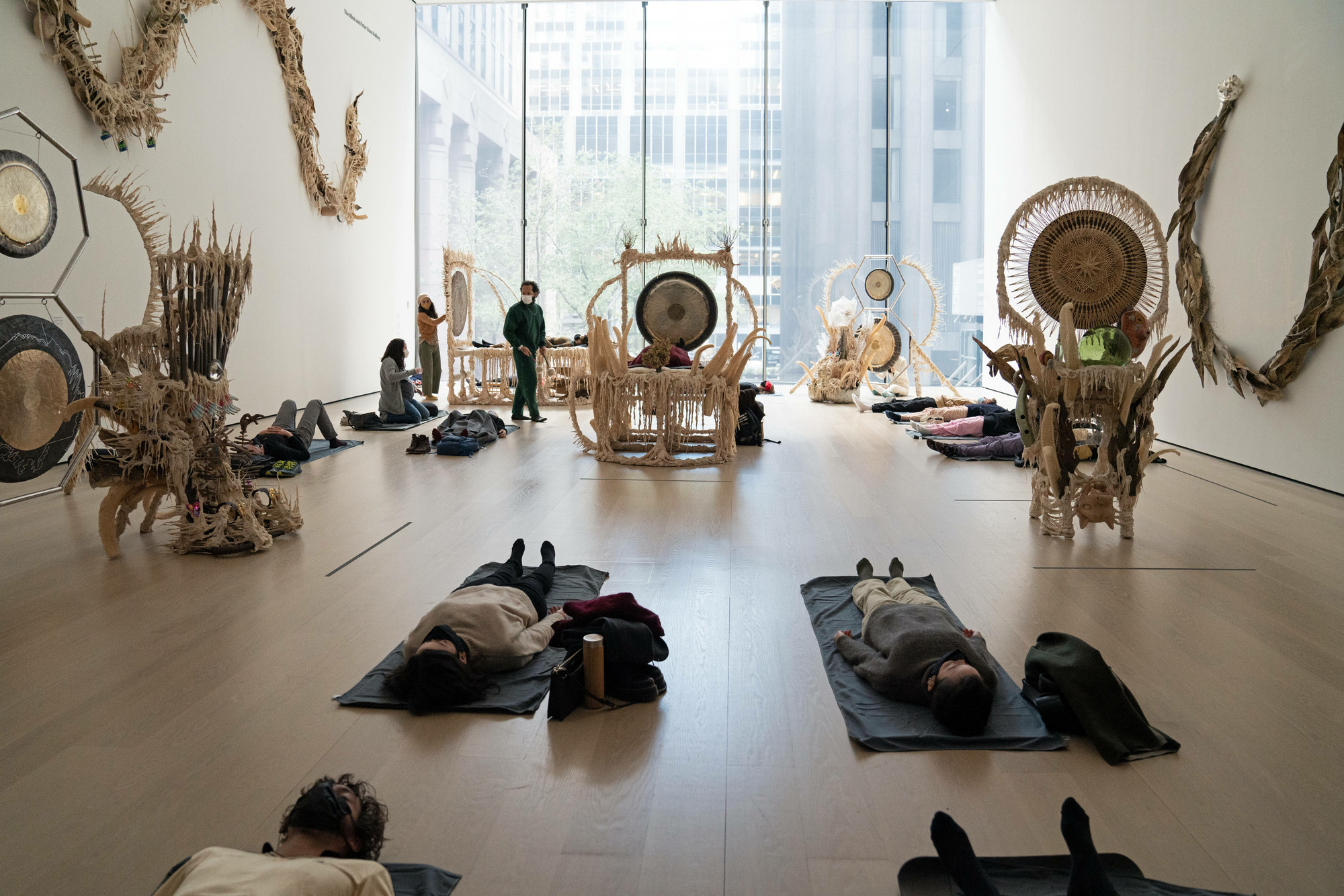
Guadalupe Maravilla: Luz y fuerza Healing Sound Baths, performed on November 3, 2021, as part of the gallery *Guadalupe Maravilla: Luz y Fuerza* in the exhibition *Collection 1970s–present*, October 30, 2021 - October 30, 2022. Performers: Guadalupe Maravilla, Hilary Ramos, and Sam Xu. Digital image © 2022 The Museum of Modern Art, New York. Photo: Julieta Cervantes

Maravilla's Healing Sound Bath at MoMA

5. The Ecstasy of Influence: A Plagiarism by Jonathan Lethem

This essay was originally published in Harper's in 2007, but I only recently stumbled across it this spring. Every single sentence in this article is plagiarized or recycled from another work. It's just brilliant and such a fantastic ode to appropriation.

You can find the essay in Lethem's collection of non-fiction essays, The Ecstasy of Influence: Nonfictions, Etc. (2012). Or, read it online in the above link.

6.  Finally, Fred Moton's Radical Critique of the Present by David S. Wallace (The New Yorker, 2018) and Moton's hybrid poem/essay come on, get it! (The New Inquiry, 2018)

The quotes below are pulled from The New Yorker article. Moton has me thinking a lot about the problems within academia and some possible alternatives, as well as how we can see past the minutia and engage with the larger world.

“I like to read, and I like to be involved in reading,” he said. “And for me, writing is part of what it is to be involved in reading.”

“Improvisation is how we make no way out of a way,” he read. “Improvisation is how we make nothing out of something.”

Saturday, May 13, 2023

Thoughts About Success


I recently read a review of a group exhibition, and the critic mentioned that in the time since making the work included in the show, some of the artists had “failed.” 


I had ideas about what the critic meant by that statement, but then I wondered what it meant to me. How does an artist fail? The main thing I could come up with was that to have failed, they would have given up on making work.* 


Around the same time I was also thinking about how we (artists) define success for ourselves.


We all have ideas about what it looks like. We see examples of success all the time, because it’s the main part of the job that’s public: the exhibitions, the awards, the publications…the lines on people’s CV’s. And there is social media, where we spotlight our success.

We know what success looks like for everyone else, but the most important thing we can do for ourselves is determining what success looks like for us. And we need to practice feeling successful in the present moment. 


 *This is not the same as taking a break from making work. Taking a break is not failure. But does the decision to give up discount all of the work an artist made prior to that decision? That doesn’t seem right.


A personal definition of success: considerations and goals


Possible considerations for defining what success looks like for us:


*Our work- does it excite us, does it challenge us, are we working to improve it, does it express our values?


*Our community- how are we showing up for others and providing opportunities or resources? Do we give more than we take?


*Our resources- what do we have space, finances, and mental/physical/emotional energy to realistically accomplish at this time?


When we consider these career components (or others), do we give ourselves related goals based on things we can control? If not, our goals for achieving success are based on external sources of validation (like shows, prizes, or anything where we have to be ‘picked’ by someone else), not solely on the work we are putting in.


As an example, a few years ago, I started the new year with several career goals. One was to apply for 3 opportunities per month. Another was to add 3 group shows to my CV for the year. The first of these goals I had infinitely more control over than the second, because having work included in shows relies on others’ curatorial decisions, but my submitting applications was a goal based on my own efforts. Some goals for achieving success are more valuable, because they acknowledge the amount of work we have done, not the way external sources perceive that work. 


When we recognize our own success based on the work we have put in, we are also practicing our ability to feel successful in the present moment.


Success in the present moment


If we want to pursue our career by seeking out external validation, we can absolutely do that. But what if the work we care most about making is never “in” during our lifetime? Or what if we never make the right connections to show in the right spaces? Do we choose to see ourselves as failures because external factors don’t work out in our favor?


During the last few years, growing awareness of ‘hustle culture’ has helped many of us consider how we treat ourselves around our perceived success (or lack thereof). We still have a long way to go.


One of the greatest successes we can have is an attitude of kindness towards ourselves. We can care about our goals and work at our highest level, while realizing that many things are out of our control. We can celebrate ourselves when we win and alternately, we can be satisfied in knowing that we did our best and will try again when our work is not chosen. We can choose our own version of success instead of waiting for The Art World to anoint us. 


My ideas about success have changed a lot over the last few years. When I think about something I want to achieve, I consider whether it really matters to me (and why), or whether it’s something I feel like I should do (in the best of scenarios, these overlap). For me, right now, success means I am treating myself with compassion and I am making work that I feel excited about. 


It’s been said that the only person we need to impress is ourselves at 17 and ourselves at 70. I agree with this, partly. Instead, I’d say that the only person I need to impress is me, right now. 17-year-old me had no idea what today-me would be dealing with, and I believe that 70-year-old me will feel proud knowing that today-me did the best that I could, even if I don’t achieve things the rest of the world considers big or important. 


Regardless, I, right now, am the only version of me that will ever exist, and in order for 70-year- old me to feel a sense of pride and achievement, I need to start practicing that for myself now.


Success, or feeling successful, is a practice, but not in the way we think. It is a feeling we must cultivate in the present moment, not one we should strive to have in the future.


Related quotes:


“You have the right to work, but for the work's sake only. You have no right to the fruits of work. Desire for the fruits of work must never be your motive in working. 

… Work done with anxiety about results is far inferior to work done without such anxiety, in the calm of self-surrender. .... They who work selfishly for results are miserable.”

-paraphrased from the Bhagavad Gita


“Success is not a goal, it’s a byproduct.”

                -Coach Taylor, Friday Night Lights


“Whether you succeed or not is irrelevant- there is no such thing. Making your unknown known is the important thing- and keeping the unknown always beyond you…”

-Georgia O’Keeffe

Saturday, March 25, 2023

Artist Profile: Bradley Chriss’ Complicated Apocalypses

by Lauren Rice


Bradley Chriss, For T.N., 2020, gouache on Paper, 17x28 inches, image courtesy of the artist


Last summer, I participated in Burnaway Magazine’s 2022 Arts Writing Incubator, Criticism as Care. In retrospect, I’m not really sure what compelled me to want to be incubated at that particular moment—I am certain that in previous years, I would have scrolled past the call for participants without a second thought. I think it was the year’s theme that struck me the most. I was already writing as Tools for Better Living on Instagram, and the ideas around the theme, Criticism as Care, fell in line with the weird and poetical way I was writing about contemporary art. Once accepted into the program, I was especially excited about the structure that it would give to my writing, in terms of a writing assignment with a set due date (I am a big fan of due dates, even self-inflicted ones). I have more to say about the experience overall, but perhaps will save that for a future blog post.

Over the course of the month-long program, I wrote an 800-word profile on an artist that I know and love, Bradley Chriss. Chriss will have a solo exhibition of work, Return of the Ash Eater, from May 1-29, 2023 at Unit.B in Baltimore, MD. You can find more about Bradley Chriss and his work on his website.


Bradley Chriss is not afraid of being complicated. Often combining figurative elements and abstract motifs like dots and dashes with a limited, primary-triadic color palette, the genre that best describes his recent gouache paintings on paper is landscape.  Chriss’ landscapes slip between representation and abstraction, creating unsettling experiences.  Solid ground is difficult to find in many of Chriss’ paintings. Instead, we surrender to the cloudy nebulae of chromatic washes, the sub-atomic overlay of tiny brushstrokes. Chriss’ topsy-turvy wonderlands are mysterious and magical, but also disturbing, absurd and tragic.

Autobiographical information is embedded within the formal attributes of his paintings.  Raised in Toledo, OH, he now observes the Blue Ridge Mountains daily from his home near Roanoke, VA.  Shifts in visibility of the mountains due to cloud cover or environmental factors serve as inspiration. The artist’s work is motivated by diverse themes such as the Anthropocene, ecological, social and political collapse, and the mixed emotions of hope and anxiety that arrived after the birth of his daughter.  Another motivator is a sincere desire to find physical and emotional healing. After relocating to Virginia, a concussion left Chriss briefly unable to work. He found therapy through acts of pleasure: by looking at and painting the natural world.

Chriss identifies the color red as a link to his Mexican heritage.  He proposes that art, like learning a language, is a way to reconnect to our missing cultural customs.  Color also serves as a connection between Chriss and his art historical ancestors.  When you look for primary triads historically, you’ll find them easily: from Fra Angelico to Frida Kahlo to Mondrian.  These artists share Chriss’ interest in exploring imagery of pain and healing, or color repetition as a method to find spiritual order after crisis.  Chriss credits ukiyo-e master Hiroshige for his compositional strategies and surrealist AndrĆ© Masson for his synthesis of imagery from the past with “modern problems”.  In contrast to the influence of the natural world, media and screens are also sources of inspiration for Chriss.  After all, the contemporary consumption of media is not a solitary activity; we watch and therefore consent to being watched. From pools of painted chroma, sentient, ethereal eyes observe us. His use of color is eye-popping, not just for the sake of fun color play, but because it must compete with the constant stream of content continually vying for our attention.

The artist happily eschews the symmetry currently en vogue with many contemporary painters working with landscape imagery. Instead, Chriss favors asymmetrical compositions and color choices that are eerily prescient of the images captured by NASA’s James Webb Space Telescope.  In the photographs and the paintings, stars dot across the heavens and the state of solid matter is in flux. Chriss’ paintings disorient spatially and compress temporally.  We are both before humanity’s dawn, and after its demise.  Chriss resists slickness in his paintings, too, opting instead for pours of paint, layered washes of Holbein gouache and urgent, repetitive dots and dabs to create galactic depth. That's not to say he lacks precision; his paintings are layered with exquisite details, deftly toeing the line between the grotesque and the beautiful.


Bradley Chriss, California Ash Falling on the Blue Ridge, 2020, gouache on paper, 19x28 inches, image courtesy of the artist


From bird’s eye to bug’s eye compositional arrangements, Chriss positions us as beings within the land or the sky. The mountains are as charismatic and changeable as the cloud formations, whose contours evoke the shapes of brains or intestines. In Waning, a painting from 2018, the clouds themselves contain skulls and entrails converging in orgiastic delight, solid forms dissipating into gaseous particles.

Chriss’ paintings elicit tension between environmental harmony and collapse. Sensual, linear descriptions of human fingers sprout ecstatically upwards from the earth, in a mycorrhizal communion with the flowers and mushrooms. In the painting, Private Interests in the Sky, the intimate scale manages to capture a vastness reminiscent of a Thomas Cole painting. We find ourselves hovering above dark, rolling hills. The world is burning and the sky rains turbulent drops of red, yellow and blue hellfire; jokey subversions of sloppy AbEx drips. In another painting, California Particles in the Blue Ridge Sky, Chriss references the drift of ash across the country from 2020’s catastrophic western wildfires in a grim dance of stippled dots.

In Chriss’ painted worlds, all parts participate in a grander, inexplicable system. We like to forget that humans are part of nature, even if, as Chriss theorizes, we were brought forth by nature as a suicide agent. When looking at Chriss’ paintings, we see celebratory acts of play and pleasure, human frailty and fallibility, and the contradictory beauty and terror of the natural world. Ghostly entities and disembodied eyes gaze right back at us, tacit, inquisitive, imploring. While cynicism is detectable, I also find its opposite: hope.


Bradley Chriss, Pressure, 2022, gouache on paper, 19x29 inches, image courtesy of the artist

Tuesday, March 21, 2023

Recent Studio Listens


What do you listen to while you work?

I go through phases when I listen to TV shows, audiobooks, or music. Right now I'm mainly listening to podcasts.

In no particular order, here are some of the podcast episodes I’ve enjoyed recently:


*Pep Talks for Artists, Episode 41: Artist Pet Peeves -This was really funny to me, and I can’t resist a non-toxic rant- actually I didn't know they were a thing until listening to this episode. Truly an art form in and of itself.


*The Art Career, Season 2, Episode 1: Mickalene Thomas: To Be an Artist is a Radical Act- Thomas’s comments on the gallery system are something I wish more people were talking about.


*Pep Talks for Artists, Episode 25: How to Work an OpeningSo useful and practical. Feeling like I’ve lost any semblance of social non-awkwardness over the past several years, I will definitely remember these points next time I attend an opening.


*Lessons From a Quitter, Episode 241: Self-LoveI discovered Goli Kalkhoran on social media, and her simple tips for mindset work always make me feel hopeful. 


*About Art with Heidi Zuckerman, Episode 64: Beth PickensI love listening to Beth Pickens. I search for new podcast interviews with her every so often, and I recently discovered this one from 2021. In it, she talks about her favorite things: artists, advice, jobs, money, death, and more. Beth is a career therapist/coach for artists, and author of Your Art Will Save Your Life, and Make Your Art No Matter What.


*Klein Artist Works: Camille SeamanNot a podcast, but so great, and so inspiring. Klein Artist Works was recommended by Virginia Broersma/The Artist’s Office.


*I Like Your Work- Chie FuekiChie Fueki has been a favorite artist of mine for a long time. This is the first time I’ve heard her talk about her work, and I loved it.


And a bonus: Sunlight PodcastA podcast about taxes (specifically catering to artists and other creatives) might seem unusual, but if you care about your money, it's an excellent source of information.


What have you been listening to lately? Feel free to leave your own podcast, TV, audio book, etc. recommendations in the comments!


Saturday, March 18, 2023

Question: Do you have a Morning Routine?


Recently, I’ve had a rash of thoughtful conversations about Morning Routines. The other day at work my friend and colleague Racquel Keller, with whom I share the painting classroom, rushed in somewhat flustered as I was packing up to leave, and she was setting up for her class.  ‘I’m feeling a little frazzled today - I didn’t get through my morning routine.’


OMG… me TOO!


Just that morning my OWN morning routine had been interrupted several times. I’d overslept. Then the kid (understandably) needed breakfast, an unexpected logistics decision had to be made, a specific shirt could not be located, the cat may or may not have contributed to some mess on the floor. Each interruption made me grumpier and grumpier, until finally I gave up in a huff, and went (begrudgingly) about my day. 


Having a morning routine is still a relatively new phenomenon for me, and as I drove to school I wondered - why do I care so much about something I’ve existed happily without for so long? Is it worth it, if I wind up dissatisfied and grumpy about an otherwise normal morning? I posed these questions to Racquel.


“I think it’s because of the pandemic. Now that things are getting back to normal, I think we feel the need to reclaim something (time? balance?) that we had when we were working from home.”


Bingo. 


I mentioned this to our Illustration teacher, Carrie Rennolds, when the subject or Morning Routines came up again a few days later. Carrie said “I don’t want to go back to deprioritizing my own needs.”


(aside: I feel very lucky to work with such insightful humans!)


I began my Morning Routine when Nikki, Lauren, and I did Julia Cameron’s The Artist’s Way together. Julia’s program mandates three full pages of long-hand, no agenda writing first thing every morning, and to be honest, I was not excited about it. I’ve never been much of a journaler, and I hate getting up early, so I was surprised by how quickly I came to depend on those few quiet moments at the start of my day. Life being what it is, I’m continually having to reevaluate, hone, and tweak the morning routine (helloooo Daylight Saving’s time). I’m also getting better at not becoming a grouch when things don’t go to plan. 


Anyway, the basic elements of my Morning Routine have emerged: 


  • Wake up before I absolutely have to

  • warm tea (ideally in a sunny chair)

  • quiet reflection time for writing (10-30 minutes)

  • a little walk outside (No bad weather, only inappropriate clothing!)


Tons of research confirms that a dose of exercise and morning sunshine does wonders for the quality of our sleep and mood, but it’s taken me a while to figure out what I get out of the writing. Back in highschool and college, I would often write, or at least refine, the thesis statement  for my papers last, which is backwards of course, but I found that I needed to blather for a while to discover what I was really trying to say. I think the morning writing does something like that for my day. I have to blather, in full sentences, about my grocery and to-do lists, and all yesterday’s minor comings and goings, before I can noodle out what I want out of today. With the morning pages completed, I find that I move through my day in a more focused way - I’m making dozens of tiny decisions that move me incrementally closer to completing  projects, and are more aligned with my core values. I’m better able to prioritize things I care about, like exercise and family time, instead of ‘saving’ those for the end of the day, when more often than not they get rushed or short-changed. It’s also a way to keep the conversations and ideas I’m exploring in the studio front of mind, even on days when I don’t make it there in person. The morning pages help me identify and accomplish teeny studio-related tasks on my off-days, which means I can be more productive when I’m actually there. 


It’s possible that I’m crossing items off my lists of goals and to-do’s at a slightly faster rate, but even if this is all in my head, I feel more satisfied with my day when I start with the Morning Routine, and to me, that makes it well worth the trouble.


So I ask you - do you  have a morning routine? And if so, what does it do for you? I’d love to hear!


Wednesday, March 1, 2023

Art Habit Introductions: Katherine Knight

Hello all, and welcome to Art Habit – a blog about art and life. My name is Katherine, and I’m one of your co-hosts here. I met my fellow contributors Nikki and Lauren in graduate school, and will be forever grateful to them for inviting me to join their monthly Zoom chats. It has been one of the most unexpected and fulfilling experiences of my life.


My brief bio reads Painter, Professor, Mom… in no particular order, but I have other interests as well… a lot of other interests (knitting, foraging, hiking, gardening (or rather, attempting not to kill my plants), sewing, swimming, yoga, paddle-boarding, treehouses… I could keep going). For years I felt guilty whenever these other interests pulled me away from the studio, but over time I’ve come to view them as a vital part of me, and my studio practice as well. After all, if I didn’t pursue these other interests, what on earth would I paint about? (This was an actual. problem. in grad school. I was ONLY in the studio for 2 years, and essentially made paintings about… nothing. Things in the studio are slower, but better now.)


As artists, we retreat into our studios, or sometimes our own thoughts, and make our work. Occasionally we poke our heads out to discuss the work, and while I’m thrilled to discuss artwork, what I really want to know is how you make your life work. I am actually asking this… of you… who are reading this right now.  How do you find time for your job, your family, your friends, your many interests and obligations, and your artwork as well? How do you continually show up for creativity and ideas? How do you make your art a habit?


If you’ve ever met me IRL, you’ll know that I love to start conversations and build community, and this is exactly what I’m hoping to do with this blog. I’ll share the things I’m pondering, and I hope to hear from you readers as well. Whether you’ve had 10 museum exhibitions (hashtag goals), or are contemplating picking up sketching for the first time, we all have the same 24 hours in our day. Let’s talk about how we spend them. 


You can read more about me, and view some of my artwork, on my website.


Short Answer Sunday: Kathleen Kennedy

Meant to elicit quick, intuitive responses, Short Answer Sunday will introduce readers to a wide variety of artists, educators, writers, ...