Showing posts with label books. Show all posts

Friday, April 26, 2024

A Review of Get the Picture by Bianca Bosker


Get the Picture by Bianca Bosker


Brief, non-spoiler review:


I really enjoyed Bianca Bosker’s Get The Picture! I think you will too if: 

  • you’re interested in what happens behind the scenes in art galleries, at art fairs, and in artists’ studios

  • you’ve wondered what makes something “art” (and what makes it “good” art)

  • you’re interested in a non-cynical take on why art matters 


Less brief review with spoilers:


Synopses about this book caught my interest, but I wasn’t planning on reading it because I thought that since I already do “get the picture,” the author wouldn’t have new info for me. I changed my mind after reading a few particularly positive blurbs about the book, and I’m glad that I did.


I had trouble at first. Bosker’s account of working with gallerists and art fairs was not the most pleasant part of the book, and I found myself wanting to shake her as she continued to doubt her own taste and look outside of herself to determine which art she should value. I had to remind myself that as a person with more than a few years of art education and art world experience as an emerging artist under my belt, my confidence in my own “eye” (Bosker discusses the development of her “eye,” or her personal taste in art, throughout Get the Picture) was something I was taking for granted.


As Bosker works on her eye, she repeatedly asks herself (and others) versions of the questions, “Do I like this artwork?” and “Should I like this artwork?” (Which can also be phrased as “Is this good art?”) She questions multiple gallerists, artists, art fair participants, art collectors, museum bigwigs, museum attendees… the list goes on. 


More and more, I noticed her surprising lack of cynicism as she moves through various art worlds (there are more than one, and Bosker notes some connections between them). She began to win me over with her dogged earnestness, but it was her multiple discussions of one of the art world’s greatest taboos: beauty, that made me root for her. 


By the end of the book, Bosker absolutely does “get the picture,” mentioning that she seeks out art viewing because she hopes to “fall in love.” When she discovers the pleasure of seeing via her experiences of color constancy I knew she had gotten what she came for. Her ode to a Brancusi sculpture at the Guggenheim seals the deal: not only does she get it, but she wants to help museum goers (and her book’s readers) get it too, in a way that is so genuinely without ego, it is a joy to read.


Bosker’s take on art, why it matters, and the ways it makes its way (or doesn’t) to all of us via the art world(s) is comprehensive and even-handed. The book is not all sunshine and roses, but darker aspects of how and why art is commodified serve to make the author’s account of her evolving love affair with art that much more compelling.


Have you read Get the Picture? What did you think?


Monday, January 29, 2024

2023 Reflections (Nikki)

Studio sun

2023 was very much a back to basics year for me, as I experienced health issues that had me researching how to get back to a better (physical/mental) baseline. Because of this, the year's overall theme was maintaining new routines. These are lessons I learn and relearn: celebrate small wins, and small steps add up. I feel hopeful that 2024 will be a great year due to changes I made in 2023.

In no particular order, five things that sustained me in the past year:


*Health changes- getting sunlight first thing in the morning, eating more, eating regularly, eating less processed food, eating more protein, going to bed earlier, strength training, getting outside more


*Reading before bed- I look forward to this so much, as it’s become part of my routine and helps me wind down. Favorite books of the year: Tomorrow and Tomorrow and Tomorrow by Gabrielle Zevin, the My Brilliant Friend trilogy by Elena Ferrante, and for art/creativity-related books: The Creative Act by Rick Rubin


*Working consistently in the studio- not a change, just something that continues to be a mainstay for many reasons


*Looking for free opportunities- paying to apply for opportunities has always been something I accepted as part of getting my work in front of new eyes, but I decided to take a break from it for most of 2023. Fortunately, I was asked to participate in shows by friends and past connections, in addition to finding free opportunities. As a professional experiment, this reminded me that I can be selective about opportunities, without feeling nervous about gaps on my CV. I’d like to continue this through 2024, but we’ll see how it goes


*Less time on social media


*And a bonus thing- easy gluten-free pumpkin muffins:


Box of King Arthur’s gluten free muffin mix- follow the directions on the box, but skip the milk and add: 15 oz. can pumpkin, 3 tsp pumpkin pie spice. Use an electric mixer or electric hand mixer to make sure ingredients are thoroughly combined


I have been making these since October and love them for all year round.


Cheers to the new year!


Thursday, August 31, 2023

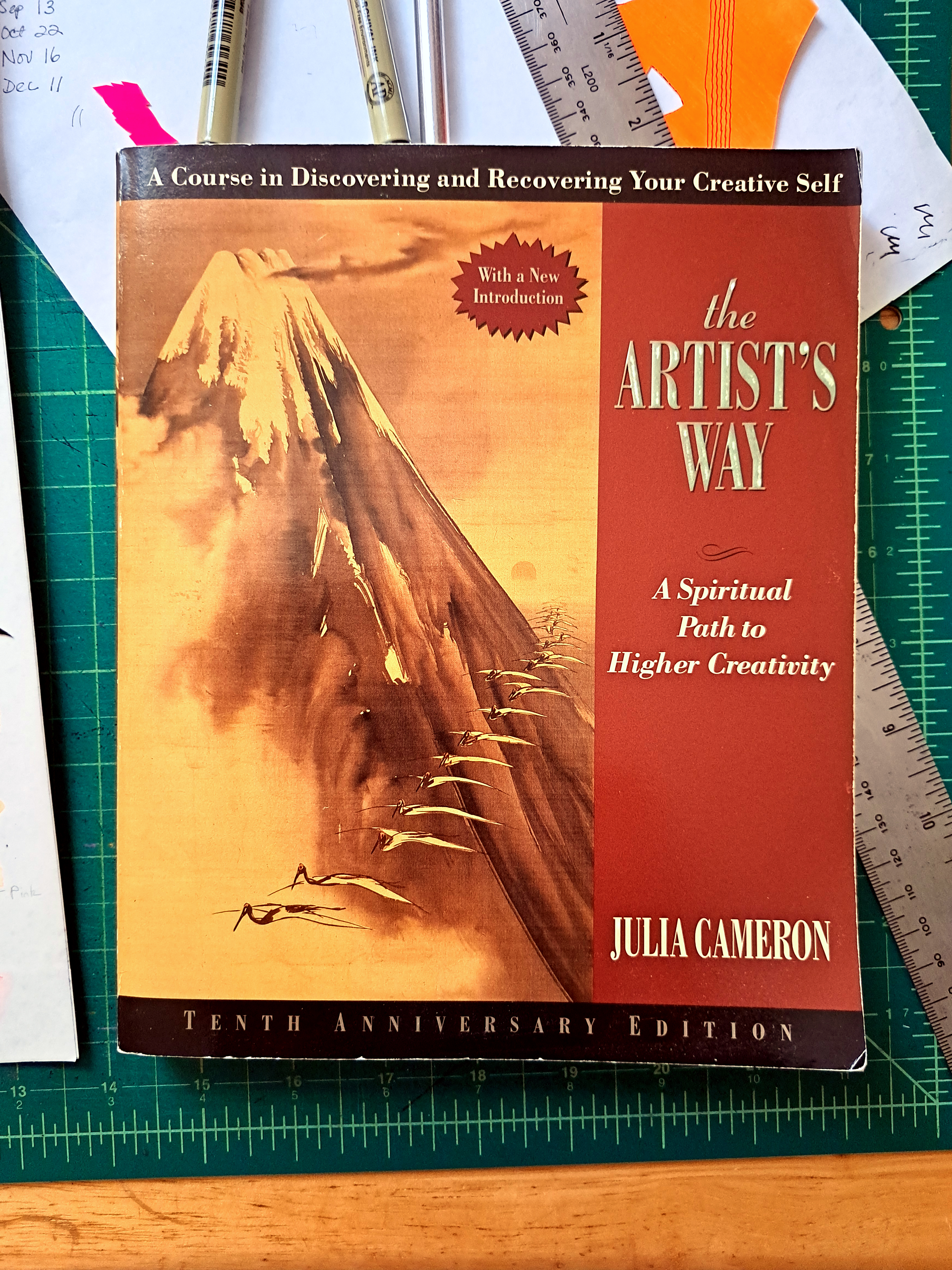
The Artist's Way: A Group Book Review


Katherine's copy of The Artist's Way by Julia Cameron with her journals full of Morning Pages

*How did we decide to do The Artist’s Way as a group?

Lauren: My memory is that I may have brought it up during one of our meetings. I noticed several groups of artists on Instagram working through the book together during the early Covid era in 2020-2021. I had also read about it in Carol Bove’s essay The Four-Hour Art Week: Read Carol Bove’s Self Help Guide for Artists from Akademie X. If Carol Bove was into it, how bad could it be? I may be wrong, but I think we started discussing it before Brian and I moved into our new house. Nikki you mentioned you had done it in the past. I think it took us a while to start, because we were in the new house when we began (November 2021?). We were all a little reluctant, I think.


Katherine: Yes - I agree with Lauren! I remember someone bringing it up in one of our monthly Zoom’s. I can’t remember if it was Nikki or Lauren, but I know that I was the only one who had never heard of it before.


Nikki: This is how I remember it too, and I think I was slightly pro- reading it, because I had also recently noticed some people posting about it on Instagram. But I also felt reluctant because I wasn’t sure I was ready to tackle Morning Pages again. But I thought it would be fun to read it with Lauren and Katherine! 


*What were your expectations or hopes going into reading the book?


N: I had read the book before, and actually felt like it led to my decision to quit a public school teaching job and apply to grad school… In some ways it feels like I owe my whole career to The Artist’s Way, so I definitely felt like big things could happen from re-reading it. I was also apprehensive, because I had tried to re-read it a second time previously and just couldn’t deal with the Morning Pages, so I felt worried I might have to (or might want to) tap out at some point.


L: I have no idea what I was expecting! I had the impression that I didn’t need the book, that it was all about being blocked as an artist. As an artist who rarely has been blocked, I doubted that it would be helpful at all. I did think that it might be helpful to share with students in the future, so I initially conceived of it as a teaching tool.


K: Lauren’s recollection about us being reluctant to start the book is spot-on. I had MANY reservations about this endeavor - it just felt like such a huge undertaking. I’m not a morning person, and I’d sworn off journaling in my early 20’s after realizing that I was just wallowing in my misery, and it made my life worse, not better. BUT - I trust Nikki and Lauren, and in the 2020 mindset I was really looking forward to doing something together as a group. My only hope was to just get through the book. I secretly gave myself permission to quit the morning journaling if it started bumming me out (sorry guys!). Spoiler alert: I’m SO GLAD I did it. The experience was every bit as transformative as everyone says it is, and I was definitely a skeptical/tough customer.


  Lauren's copy of The Artist's Way


*How would you describe The Artist’s Way to someone who hasn’t heard of it?


L: A guidebook for cultivating and supporting creativity. Full of lots of practical guidance, tactics, questions, observations and rules! But it’s more than that. It’s a spiritual experience. I just noticed that Julia Cameron refers to it as a “sourcebook”! That works!


K: I would say that The Artist’s Way is a program that helps you discover, confront, and ultimately dispel whatever biases you have about yourself and your artwork. It’ll help you clear the air in your own head, so you can get down to the business of practicing your art.


N: The Artist’s Way is a book that contains exercises focused on creativity. It’s not just like ‘let’s make something’, though. It's more meta in the way it approaches creativity, because it asks you to consider certain attitudes that affect how you approach creativity and how you can remove roadblocks in order to freely create. It directs you to think about how you think about creativity.


*What did you like most about reading the book (and why)?


L: It pushed me out of my element! I liked this, but it wasn’t always comfortable!


Prior to starting the book, my studio practice already felt expansive. With The Artist’s Way as a guide, I opened up to other art-adjacent areas that I have been interested in but never really wholeheartedly pursued. For instance, writing about art. Not only did I not feel particularly confident about my writing, I felt that pursuing writing would be a distraction from my so-called “real” work in the studio. The Artist’s Way helped me to see that both are intertwined and do not have to be mutually exclusive. At the risk of sounding like a really slow learner, I finally realized that I do not need anyone’s permission to write about art, that I could write how I wanted, I could write about anything I wanted and I could be inconsistent, silly, weird, and so on. 


Another important focus was the process of defining “success” for myself. Similar to my earlier thoughts on writing, I think my initial definition of “success” revolved around other artists, curators, critics, gallerists, etc. responses to my work. The book helped me to find the edges of my own, personal definition. Finishing the book actually felt like the beginning of the path–doing the book was kind of this odd, intermediary metamorphosis phase where lots of new ideas were just beginning to bubble to the surface.  I am still working on a personal definition of success, but this process has been pretty profound and reinvigorating for my artistic practice and my outlook on life as a whole.


K: I was surprised to find that I loved writing the morning pages, and am still doing them (almost) daily! I’ve written more about my experience with morning pages here.


N: Each time I have read the book, Julia Cameron’s compassion towards creatives has stood out, and so has the way she encourages us to be kinder to ourselves. The first time I read it, I was struck by the section about the ‘Inner Critic’, and how (according to Cameron) this mean monster way of treating ourselves and our work didn’t have to be something we keep doing. The information is just as poignant now, as I still have to work on separating from my Inner Critic, and I probably always will. 


Lauren's The Artist's Way and her Morning Pages journals


*What did you like least about reading the book (and why)?


L: One of the hardest parts for me were the affirmations. I didn’t feel like I got much out of them, but I think I may not be taking them seriously enough. I thought that writing every morning would be the hardest component, but I really got into the morning pages. In fact, I still write three pages every morning.


If I’m being honest, artist dates were also a major challenge for me. I love the idea of artist dates, but found them really hard to fit into my schedule between teaching, the studio, parenting and having a life. It was really challenging to give myself that time! I did do the artist dates every week, but they were pretty tame.  If I did the book again, I would push the adventurousness of my artist dates.


K: I agree with Lauren - the affirmations were tough for me. I really tried hard, but they just felt silly, and like I was trying to affirm things that were ultimately out of my control. I quit doing them.


N: Morning Pages were/are a tough commitment for me, because I often feel impatient and like I am wasting time while writing them. The second time I tried to read/do the book, I quit because I didn’t want to do Morning Pages, and I didn’t feel right about reading the book without also doing the exercises. I’ve gotten around that this time by being more flexible with my expectations for the writing (instead of doing 3 pages, I do one, I usually don't write on weekends, I don’t always write in the morning, etc.). I know I’m not getting some of the intended value by not writing the full 3 pages, but I am still getting something important from them by developing a strong relationship with my inner voice. 


Artist Dates are also tough, but for some reason I’m not as hard on myself about not getting those in each week as I am about the writing. Maybe because since they seem fun, I don’t feel guilty when I miss them. This definitely says something about internalized ideals and expectations around “work” versus “play”... something to think about.


*How did the book change the way you think about your work or yourself?


L: I think it changed the way I think about myself, more so than my work. That’s really what I needed, a way to feel more confident in myself even if I was not getting outside reinforcement. It helped me to develop a more nurturing inner voice, as well as develop more constructive relationships to success, work and time.


K: The book really changed the way I view my artistic practice in relation to other parts of my life. I have a lot of other responsibilities and interests, and I used to feel guilty about not spending enough time in the studio, especially whenever I was ‘indulging’ in something for fun, vs work or family obligations. Completing The Artist’s Way helped me find peace around all of this. Not only do I feel a lot less guilty about pursuing these other interests, but I’ve come to view my wide ranging skill set as something of a super power, and am now looking for ways of folding these skills and interests into my studio practice. The Artist’s Way helped me feel like a whole person, instead of feeling like my attention was constantly being pulled in different directions.


N: Detaching from my Inner Critic, was (and is) a really big deal for me. 


Acknowledging the importance of play in the creative process via Artist Dates has also helped me follow different routes in the studio and take time to consider ideas that might otherwise have seemed like sidetracks. 


The Artist’s Way was the first authoritative voice for me that said it was good to embrace the things you love and that bring pleasure and joy (in making your work), and that it’s okay to enjoy these things without having to rationalize and verbalize the meaning of it all. 


Looking for synchronicities every week and every day has also become important thanks to The Artist’s Way. It feels like a different, more magical take on a gratitude practice.


Nikki's copy


*Who would you recommend this book to? What do they need to know before they start?


L: I’d recommend this book to art students, people who think that they’re not creative, all artists/creatives, even people that think they don’t need it. Maybe everyone needs this book?!


Follow the rules! Do the hard questions/tasks (I’m 100% talking to myself here, as I bent a lot of the rules and tried to avoid some questions and prompts that I didn’t want to answer).


K: Honestly, I think this book would be perfect for anyone with big goals, whether or not they’re art related. The book’s real power is helping the reader create structure and discipline that are tailored to their life, and therefore easier to maintain long-term, but it takes work. I would advise anyone considering this book to be sure to give it enough time - at least 30 minutes to an hour of writing each day (sometimes more), and several more hours each week for reading and Artist Dates. I was really grateful to have started it over Winter Break, so I could get used to the routine before my spring classes started.


N: I would recommend the book to any artist, and anyone who engages thoughtfully with the creative act. You will get out of it in direct proportion to the effort you put in. AND if you can go through it with a small group of creative people who are serious about it, and who will do the weekly check-ins, your experience will be enriched, because learning how The Artist’s Way is working for others will help you see better the ways it’s working for you too. It is great to do the book by yourself, it’s incredibly valuable either way, but if you can read and share about it with people you trust, the experience will be richer. 


I am not being hyperbolic in saying the book has changed my life each of the times I have read it, and I am so grateful to Lauren and Katherine for being part of that this time around.


*Will you read/do The Artist’s Way again? Why/why not? If yes, when?


N: I will do The Artist’s Way again, but I don’t know when. I’ve (mostly- I took a break for 2 weeks) continued the practice of the Morning Pages since completing it this last time, but I allow myself to do a daily (on weekdays) abbreviated version (about a page) in order to keep it going. It’s been a useful practice to check in with myself and get grounded. Every time I’ve undertaken The Artist’s Way (except for the first time when I didn’t know what to expect), I’ve felt apprehension and dread about committing to the Morning Pages all over again, and I think I would still feel this way coming back to it for a fourth time. I don’t know why they feel like such a hurdle, BUT I also feel excited about when it will seem like the right time to do the book again. 


L: I will definitely do it again. I’ve also continued to write morning pages and check-in weekly with Nikki and Katherine. I have also periodically looked back through the book, when I’ve felt like I needed a reminder.


I don’t know when, but I have a feeling that I will go through the entire book again, at some point!


K: The Artist’s Way still feels so present, it’s hard to imagine doing it again! But I could see myself doing it the next time I feel stuck.  I’m currently working towards a show next year. It’ll be my biggest solo show so far(!!) and I definitely would not have landed without doing The Artist’s Way, and Nikki and Lauren’s support! The last time I completed a big project, I felt stuck and directionless for about a year. I would definitely consider doing The Artist’s Way if that happens again, but then again, the morning pages are helping to generate so many ideas that it may not happen this time. We’ll see!


Have you completed The Artist's Way? How was your experience? We would like to hear about it! Please share in the comments.


Wednesday, July 19, 2023

Interview with Rachel Jeffers: Painting and Passing Notes


Installation view of "Knock Turn" at Shockoe Artspace


I have been a fan of Rachel Jeffers’s work since I first saw it in McLean Project for the Arts’ "Strictly Painting" show in 2019. After meeting at the exhibition’s opening, I’ve gotten to know Rachel, and while I have been impressed by her sincerity and her work ethic, her solo show, “Knock Turn” at Shockoe Artspace blew me away. (It is on view through July.)

Rachel’s show of fifty paintings is full of surprises, and there is a sense of serious, yet playful discovery in her variety of material applications. Coupled with the works’ shifting figure-ground relationships, hazy atmospheres, and references to everyday objects, it makes for a viewing experience rich with the mundane-turned-magical.

Rachel is also involved in several unique artist communities, one of which being the publication Passing Notes. I asked her to answer a few questions for Art Habit to spread the word about her wonderful exhibition and how she is creating opportunities for other artists.

-Nikki/Art Habit

"Knock/Turn", oil on panel, 20" x 16", 2023


Art Habit: How did you decide you wanted to be an artist?

Rachel Jeffers: I don’t remember consciously making this decision; I always said I was going to be an artist. But the first time I remember seeing myself as an artist was in first grade. We were told to think of a story we knew and design a book cover for it. My sister had just played the part of Little Miss Muffet in her third-grade play the night before, so that’s the story I chose. I remember the excitement of knowing exactly what I wanted to make, and then sitting at my desk making it. I can still picture where my desk was positioned in the classroom, and then it’s like the entire world fell away as I worked. Later, I saw my drawing posted on the cafeteria wall, and it had been awarded a blue ribbon! The recognition was meaningful at that age because it felt like confirmation that this thing that had brought me such joy was the right fit for me.


"Steam", oil on clayboard, 11" x 14", 2023


AH: How do you choose what to paint? What kinds of subjects or ideas inspire you to make a painting?

RJ: The ideal scenario is when I’m already deep into a body of work and new ideas for paintings are prompted by the work I’m making. There are so many decisions involved in the process of making a single painting – each choice could take things in an entirely new direction. It’s like parallel worlds that could just keep going infinitely. Another thing that happens when I’m absorbed in a body of work is that I begin to look at my everyday environment with a painter’s eye, and more and more subjects begin to seem relevant.

If I’m between projects, or looking to change to a new subject, I have found that it’s dangerous for me to overthink it too much. It’s better to just start painting. I try to pay attention to what I pay attention to in my everyday life, and then use that as a jumping off point. Once I start painting, the work will generate its own inspiration, or - more likely - its own problems that I feel compelled to solve.


"Cut Flowers", oil on clayboard, 9" x 12", 2022


AH: How do you think about “beauty” as related to the work you make?

RJ: I’m more interested in metaphor than I am in beauty. Some paintings are more beautiful than others but for me, the most interesting painting is one that prompts thought, or holds attention – art as a form of visual poetry. A painting is the direct result of my level of engagement with the materials and with the world around me at the time that it was made. Attentive, honest engagement, for me, is the aim.


"By the Light", oil on 2 panels, 11" x 14" and 7.25" x 6.28", 2020


AH: What are you currently reading that you’re excited about? What books do you like to recommend to other artists (and why)?

RJ: Three books I’m excited about right now are: The Pensive Image by Hanneke Grootenboer – it is about art as a form of thinking and explores the way looking at paintings prompts thought; Ways of Drawing from the Royal Drawing School has some really great contributions from a variety of artists about the practice and purpose of drawing; The Master and His Emissary, by Iain McGilchrist, about how the divided brain hemispheres work together and how their structure in the brain impacts our world and culture. I’ve always been fascinated by the left brain/right brain divide, and how this influences the process of making art and talking about art.

Other favorite art books include Mysteries of the Rectangle by Siri Hustvedt - I appreciate this book from the point of view of a writer, attempting to translate a visual experience into words. I recommend Looking at the Overlooked by Norman Bryson to anyone interested in still life painting, and the last chapter of the book in particular Still Life and Feminine Space which is about masculine versus feminine approaches to composing paintings. The Art Spirit by Robert Henri is a lovely book for painters. My all-time favorite art writer is Rudolf Arnheim, who breaks down the psychology of images in a thorough, dense, but still approachable way, particularly in the books Visual Thinking and Art and Visual Perception. And I have to mention The Alphabet Versus the Goddess by Leonard Shlain, which explores the impact of left brain (masculine) versus right brain (feminine) values throughout the history of various cultures, and the ways in which the prioritization of one set of values over the other has set the world off balance.


AH: How would you describe Passing Notes for readers who are unfamiliar with it? How did it come to exist?

RJ: Passing Notes is a magazine that showcases the writing of visual artists. In 2021 I took an online writing class with NYC Crit Club. The class was made up of artists who enjoy writing and were looking to develop our skills and connect with others who share our love of words and images. We were excited about the writing that was being created – there’s so much thoughtful writing out there that artists do that is never seen by anyone. So a group of us created Passing Notes to serve as a platform for artists who write. We see this as a way to build community and dialogue among a wide range of artists who are making work but who aren’t necessarily being shown in big galleries or written about in art publications. We are currently in the production process for Issue 3, which will be released this fall. Issues 1 and 2 can be found online, or you can order a print copy through our website.


"Cul-de-sac", oil on panel, 9" x 12", 2021 


AH: What advice do you have for artists who are considering how they might create opportunities for other artists?

RJ: Just get started! You can learn and build as you go. I think it’s easy to assume that we’ll be judged harshly when we try something new but in reality, when it’s something you’ve put your heart into, people will sense your passion and most people will be generous and supportive. Many artists are in need of community so if you see a specific need out there that you think you can help fill, your efforts will be of value to someone.


"Setting", oil on panel, 16" x 12", 2022


AH: What is coming up for you that you’d like to spread the word about? Where are online places readers can learn more about you and your work?

RJ: I’ll be giving an artist talk on July 29 at Shockoe Artspace in Richmond, VA. My work can be seen on my website at www.racheljeffers.com and on Instagram @racheljeffersstudio. Passing Notes' website is www.wannapassnotes.com and our Instagram is @_passingnotes.

Thank you, Rachel, for taking the time to share about your work!


**All images courtesy/copyright the artist.**


Saturday, May 20, 2023

Summer Reading: Six Offerings

For my astro folks, ya'll know my 3rd house Taurus moon loves books. It's a problem, but a problem I'm willing to indulge in. As my writing of late has been somewhat intermittent (end of semester + Berlin study abroad + upcoming collaborative project in June !!!), I've put together a list of some books and articles that I've recently read or am currently reading. See?! You, too, can benefit from my bibliophilia. Hope you enjoy!

 
1. The Rise: Creativity, the Gift of Failure and the Search for Mastery by Sarah Lewis (2014)

This book is a must-read for all creative types.  My favorite chapter? The Grit of the Arts, which begins with a Rebecca Solnit quote, "The stars we are given. The constellations we make". I'll hold off on saying much more, because you should really just read it!

 
2. Wicked Arts Assignments: Practising Creativity in Contemporary Arts Education, Emiel Heijnen & Melissa Bremmer (eds.) (2020)

I am sucker for books about art assignments, especially those that consider the craft of creating an assignment an art form in and of itself. This one has a great intro revisiting the impact of Fluxus on art making and it's influence on contemporary art education.


3. The Creative Act: A Way of Being by Rick Rubin 

I knew nothing about Rick Rubin until I heard him interviewed on Krista Tippett's On Being podcast about a month ago. Immediately smitten, I've since listened to him speak on many other podcasts, including his own, Broken Record. If I could bottle his zen-like confidence, I'd be a millionaire. So much big Jupiterian energy.
 
Here's a quote from pg. 135, the page I am currently on:

Discipline and freedom seem like opposites. In reality, they are partners. Discipline is not a lack of        freedom, it is a harmonious relationship with time.


4. Your Brain on Art: How the Arts Transform Us, by Susan Magsamen and Ivy Ross (2023)
 
The newest book on the list and one that Katherine, Nikki and I are currently reading together for our 
S L O W book club (one chapter/week).  Some great statistics on how the arts promote our well-being and benefit the health and plasticity of our brains, literally creating new neural pathways. A pretty solid argument for the importance of art in education as well as art as a daily habit. 

A question: How might we differentiate between art as therapy for health and healing and art with a capital A. OR....is there no distinction?

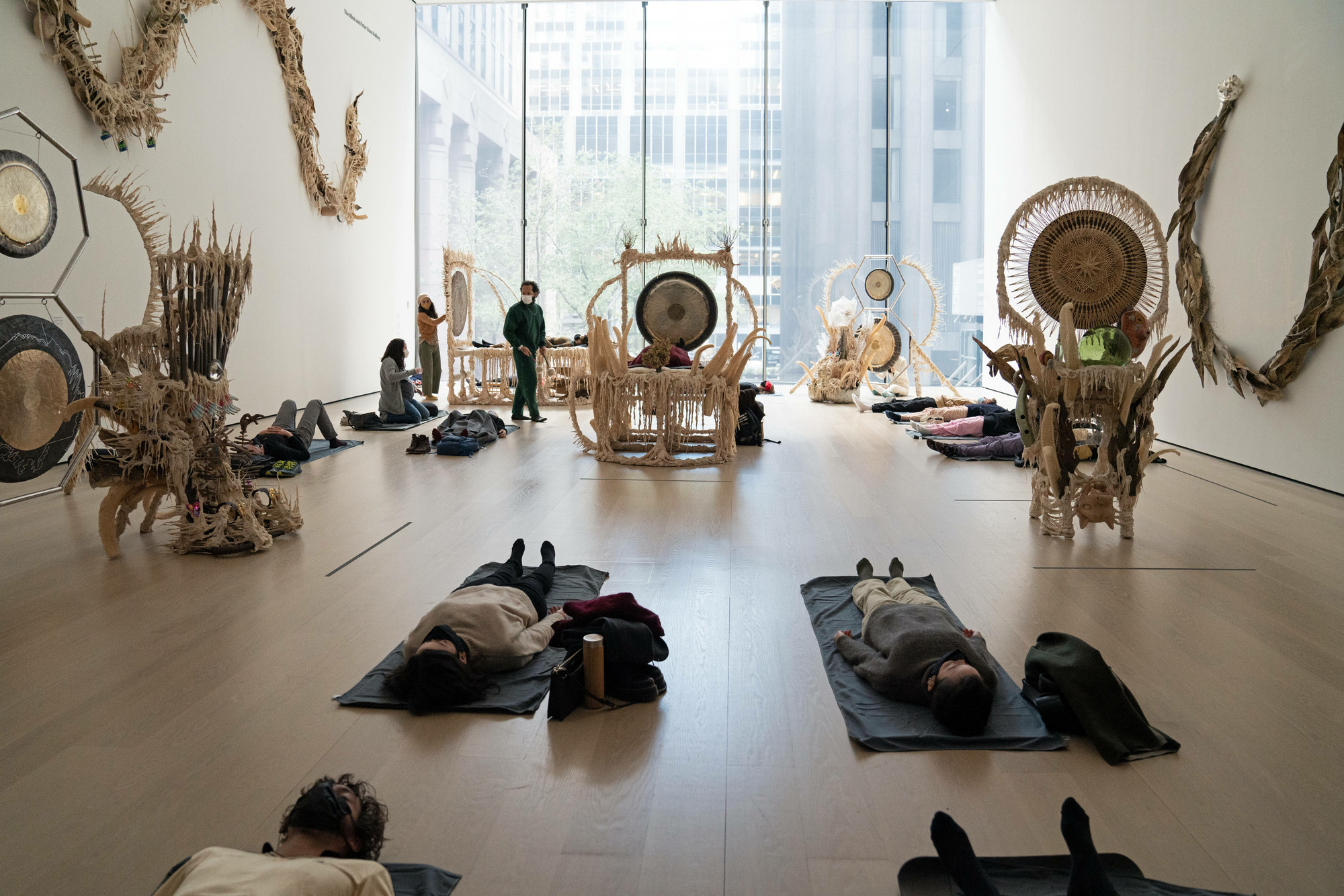
Thinking of the fantastic contemporary artist Guadalupe Maravilla and an essay in his newish monograph Portals (ICA Miami, 2021). The essay, written by Kency Cornejo, is called Sonic Healing in the Age of Border Imperialism: The Art of Guadalupe Maravilla.

Cornejo writes:
        
Sound, a way of knowing and being in the world, emanates from and penetrates our bodies with invisible vibrations. Sound literally touches us; it orients our bodies in place and time. As with our other senses, sound shapes and triggers our memories, and, in doing so, can wound us. But can it also heal us?

Guadalupe Maravilla: Luz y fuerza Healing Sound Baths, performed on November 3, 2021, as part of the gallery *Guadalupe Maravilla: Luz y Fuerza* in the exhibition *Collection 1970s–present*, October 30, 2021 - October 30, 2022. Performers: Guadalupe Maravilla, Hilary Ramos, and Sam Xu. Digital image © 2022 The Museum of Modern Art, New York. Photo: Julieta Cervantes

Maravilla's Healing Sound Bath at MoMA

5. The Ecstasy of Influence: A Plagiarism by Jonathan Lethem

This essay was originally published in Harper's in 2007, but I only recently stumbled across it this spring. Every single sentence in this article is plagiarized or recycled from another work. It's just brilliant and such a fantastic ode to appropriation.

You can find the essay in Lethem's collection of non-fiction essays, The Ecstasy of Influence: Nonfictions, Etc. (2012). Or, read it online in the above link.

6.  Finally, Fred Moton's Radical Critique of the Present by David S. Wallace (The New Yorker, 2018) and Moton's hybrid poem/essay come on, get it! (The New Inquiry, 2018)

The quotes below are pulled from The New Yorker article. Moton has me thinking a lot about the problems within academia and some possible alternatives, as well as how we can see past the minutia and engage with the larger world.

“I like to read, and I like to be involved in reading,” he said. “And for me, writing is part of what it is to be involved in reading.”

“Improvisation is how we make no way out of a way,” he read. “Improvisation is how we make nothing out of something.”

Short Answer Sunday: Katherine Knight

Welcome to Short Answer Sunday , an interview series where I ask artists, art adjacent individuals, and other interesting, creative people t...