Showing posts with label Nikki. Show all posts

Tuesday, July 30, 2024

The Art of Collage at Second Street Gallery

I have shared thoughts both about success and about rejection from juried shows, so I thought it would be fitting to share images from a recent juried show success that I had. I applied to be part of a collage show at Second Street Gallery last year, and The Art of Collage curated/juried by gallery director Kristen Chiacchia was the result of that call for work.

I was especially pleased to be included as one of 13 Featured Artists among the show's 41 total artists. There were so many interesting details in the many works included, images truly do not do them justice, but I will provide additional links if you want to learn more about the exhibition and some of the artists. 

All installation images are by Stacey Evans.


Works on the left wall are by (from left): Jonathan Lee, Sharon Shapiro, Blythe King, Hannah Diomataris


Artists from left: me, Sri Kodakalla, Zofie King, Lisa Macchi


Artists from left: various (see Second Street's list of participating artists), Cassie Guy, Richard Alonzo, Laura Wooten, me, Sri Kodakalla, Zofie King


Foreground image by Kay Vass Darling


The show was up from June 7th through July 19th.

Part of celebrating success is sharing it with others, so thank you for coming along as I practice sharing and taking up space here on the blog.

Wednesday, June 12, 2024

Reflecting on Rejection: Two Reasons We're Not Getting Into Juried Shows


When you submit work to a juried show and it gets declined, do you check out the show after it’s up (either online or in person)? Or is your attitude more along the lines of trying to forget about the rejection letter and moving on to other things?

For as long as I have been applying for shows, my feelings aligned with the latter, and I didn’t see much value in dwelling on what felt like missed opportunities. In the last couple of years, I’ve gotten curious about jurors’ and curators’ tastes and what work fits what they’re looking for, and why my work sometimes has not.


Assuming that we are meeting the basic entry requirements for a show (providing excellent images of strong work, fitting our statements into word count limits, etc.), there are two main reasons I’ve noticed for why my (and probably also your own) work hasn’t been included in juried shows. One of them may surprise you.


The least surprising reason for a rejection: the work doesn’t fit with the whole of the show. This can be a case of “the juror just didn’t like it,” but it can also be more subtle, relating to slight formal or conceptual mismatches. One of the first things I look for when I am trying to figure out why my work didn’t get into a show is the exhibition’s overall formal vibe; often, my colorful, graphic work presents a glaring contrast to a group of work that has softer edges or more muted colors. 


Conceptual mismatches can be harder to pinpoint, and if a juror provides a statement about their selections, this is helpful. I recently submitted work that was declined from a ‘nature’ themed show, and even after reading the juror’s statement and viewing the accepted work, I was struggling to determine why my work was not a fit. I was about to chalk it up to “they just didn’t like it,” (which may also have been the case) when I finally realized that all of the works in the show were speaking to broader topics relating to the natural world, like climate change, sustainability, etc., while my work instead presents a quirky microcosm that is more about a single moment in time. 


After I realized this, it seemed obvious, but it can be difficult to consider our work objectively. This kind of thinking is valuable, because considering why our work isn’t included in a show can point us towards contexts that will be a better fit.


A more surprising reason for our work’s rejection from a show: our work is already in the show. By this, I mean there is work included in the show that is visually very similar to ours. “Very” is subjective and sometimes hard to determine because we are able to attune to all the ways our work stands out that may not be as apparent to a juror, especially when they have just viewed 599 other applications. In this case, there may also be something else in the application packet that gives the selected work a leg up. For example, if CV’s are part of the application requirements, the selected artist’s CV may be more developed than our own.


This happened to me several years ago, when I noted in a group show I had been rejected from work that, like my own, was very colorful, with graphic edges and lots of patterns. However, I knew this artist’s name and was even familiar with curatorial projects they had developed. It was easy to see that while my work might have filled the same visual slot as this artist’s, their more prestigious CV could add value to the group exhibition in a way that mine could not.


It is always disappointing to get a rejection letter for an opportunity that we want, but if we take the time to consider the larger picture of where our work fits (or doesn’t) and why, we may* be able to pick better suited opportunities going forward. 


*To some degree, applying for things is always a roll of the dice. But we only have a chance at getting the things that we do apply for.


Friday, April 26, 2024

A Review of Get the Picture by Bianca Bosker


Get the Picture by Bianca Bosker


Brief, non-spoiler review:


I really enjoyed Bianca Bosker’s Get The Picture! I think you will too if: 

  • you’re interested in what happens behind the scenes in art galleries, at art fairs, and in artists’ studios

  • you’ve wondered what makes something “art” (and what makes it “good” art)

  • you’re interested in a non-cynical take on why art matters 


Less brief review with spoilers:


Synopses about this book caught my interest, but I wasn’t planning on reading it because I thought that since I already do “get the picture,” the author wouldn’t have new info for me. I changed my mind after reading a few particularly positive blurbs about the book, and I’m glad that I did.


I had trouble at first. Bosker’s account of working with gallerists and art fairs was not the most pleasant part of the book, and I found myself wanting to shake her as she continued to doubt her own taste and look outside of herself to determine which art she should value. I had to remind myself that as a person with more than a few years of art education and art world experience as an emerging artist under my belt, my confidence in my own “eye” (Bosker discusses the development of her “eye,” or her personal taste in art, throughout Get the Picture) was something I was taking for granted.


As Bosker works on her eye, she repeatedly asks herself (and others) versions of the questions, “Do I like this artwork?” and “Should I like this artwork?” (Which can also be phrased as “Is this good art?”) She questions multiple gallerists, artists, art fair participants, art collectors, museum bigwigs, museum attendees… the list goes on. 


More and more, I noticed her surprising lack of cynicism as she moves through various art worlds (there are more than one, and Bosker notes some connections between them). She began to win me over with her dogged earnestness, but it was her multiple discussions of one of the art world’s greatest taboos: beauty, that made me root for her. 


By the end of the book, Bosker absolutely does “get the picture,” mentioning that she seeks out art viewing because she hopes to “fall in love.” When she discovers the pleasure of seeing via her experiences of color constancy I knew she had gotten what she came for. Her ode to a Brancusi sculpture at the Guggenheim seals the deal: not only does she get it, but she wants to help museum goers (and her book’s readers) get it too, in a way that is so genuinely without ego, it is a joy to read.


Bosker’s take on art, why it matters, and the ways it makes its way (or doesn’t) to all of us via the art world(s) is comprehensive and even-handed. The book is not all sunshine and roses, but darker aspects of how and why art is commodified serve to make the author’s account of her evolving love affair with art that much more compelling.


Have you read Get the Picture? What did you think?


Saturday, March 9, 2024

Interview with Alexandra Chiou: Intricate Collages and Collected Thoughts


Installation view of "Remember/Renew" on view at IA & A at Hillyer


I met Alexandra Chiou via Instagram in 2019 when we started messaging about the in's and out's of framing methods. Since that time, I have discovered Alexandra to be one of the most talented and generous artists that I know. 

Her intricate hand cut paper works feel both earthy and ethereal, delicate and emotionally resonant, qualities not often seamlessly combined. The swirling movement within each work calls to mind breezes, streams, and other sources of gentle flow in the natural world.

Alexandra's work ethic is always inspiring, and I am so pleased that she agreed to answer questions for Art Habit, so we can spotlight her beautiful cut paper work, and also to share about her solo exhibition, on view now through March 31st at IA & A at Hillyer in Washington, D.C. 

                        -Nikki/Art Habit


"Rebirth"

Art Habit: How long have you been making your cut paper pieces? What led you to make this type of work? (Did you draw/paint before?)

Alexandra Chiou: I've been working with this current method since around 2015, so it's been about 9 years now. I started as an oil painter, but after graduating from college, I was working out of my apartment and had limited storage space, so I started painting with acrylic on paper instead. Eventually, I began experimenting with collage. I have always been interested in sculpture, and started playing with the layers of paper in my pieces. We have so many complex emotions and feelings, and I love how the layers are a way of representing the depth of what we feel and experience.


AH: How do you think about “beauty” as related to the work you make?

AC: In my latest work, I think about beauty in the sense that I celebrate moments and memories of hope, joy, wonder, and love. That being said, you cannot have light without darkness, and often the most traumatic and challenging experiences shape us and make us who we are. It's important to accept all the good and the bad and to come to terms with the entirety of our experiences. My work is about finding healing, feeling uplifted, and being at peace.


"The Voyage"

AH: You have lived in some interesting places over the last few years. What have been your favorite things about each city you have lived in?

AC: I've been fortunate enough to live in the DMV, LA, and currently the Boston area. Every place I've lived in, I've met very generous and welcoming people in the creativity community, which is something I have really appreciated and cherished. Living elsewhere has made me even more appreciative of the number of amazing nonprofit art spaces in the DC area and the fact there are so many free world-class museums nearby. If you live in the DMV, definitely don't take that for granted!


AH: Do you have a morning routine (if yes, please describe it)? What other routines have you established that help you make your work?

AC: I usually stretch and do some sort of exercise. Being physically active helps boost my energy and overall mood, and it makes me more productive. I also generally work on my art in the mornings. Even if I only have time to do 15-30 minutes worth of work (which happens on some days), I do a little every day and it really adds up in the long-run.


"Home"


AH: You do a great job connecting with galleries. What advice would you give artists that want to work with more galleries?

AC: I'm still navigating this myself, but I recommend doing your research and being very deliberate about galleries you want to potentially connect with. Make sure they are a good fit. Do you like the work they show? Does their mission resonate with you? Could you see your work fitting with their current roster of artists? Once you've identified galleries you're interested in, visit in person and attend their events. They will appreciate the support and it will not go unnoticed. Try to get to know them better as people, not just as a gallery. 


Installation view of "Remember/Renew" on view at IA & A at Hillyer


AH: Where can readers learn more about your work? Do you have exhibitions or upcoming events you’d like to share?

AC: Viewers can learn more about my work at alexandrachiou.com or on my Instagram at @alexandrachiou. I currently have a solo show, "Remember/Renew" up at IA&A at Hillyer in DC. The exhibit will be on view through Sunday, 3/31. I will also be giving an artist talk at IA&A at Hillyer on Thursday, 3/21 at 6:15pm for any readers who want to learn more about the show and my practice. Hope you can stop by!

Thank you, Alexandra, for taking the time to share about your work!


**All images courtesy/copyright the artist.**

Thursday, February 29, 2024

How Do You Protect Works on Paper? An Informal Materials Test

 In December of 2022, I decided to run a test to determine a couple of things:

  1. How lightfast (resistant to fading or changing caused by light) are my most commonly used collage materials?

  2. How well-protected are these materials by my usual framing methods (UV resistant plexiglass)?

  3. Should I incorporate UV protective spray for additional protection? 


Works on paper can be delicate and susceptible to changes caused by light exposure. I also use a lot of fluorescent colors in my work, and even with protection, fluorescent pigments change over time. I had recently discovered Lascaux UV Protect spray, and I was excited that it could further preserve my work in addition to the UV resistant plexiglass I already include in my frames. 


Initially, I planned just to treat some scraps with the Lascaux spray and leave them in a bright window for a while, but after thinking more about it, I decided to run several tests:


  1. A full sun control collage- no UV resistant spray or plexi

  2. A fully protected collage- treated with both UV resistant spray and covered by UV resistant plexiglass

  3. Collage treated with UV resistant spray (no plexi)

  4. Collage covered by UV resistant plexi (no spray)

  5. No sun control collage- kept in a cigar box in a flat file drawer


I ran the exposure test from December of 2022 through December of 2023, with all collages placed in a window that received southeast sun exposure for at least 4 hours each day of an average Virginia year (usual amounts of sun/cloudiness).


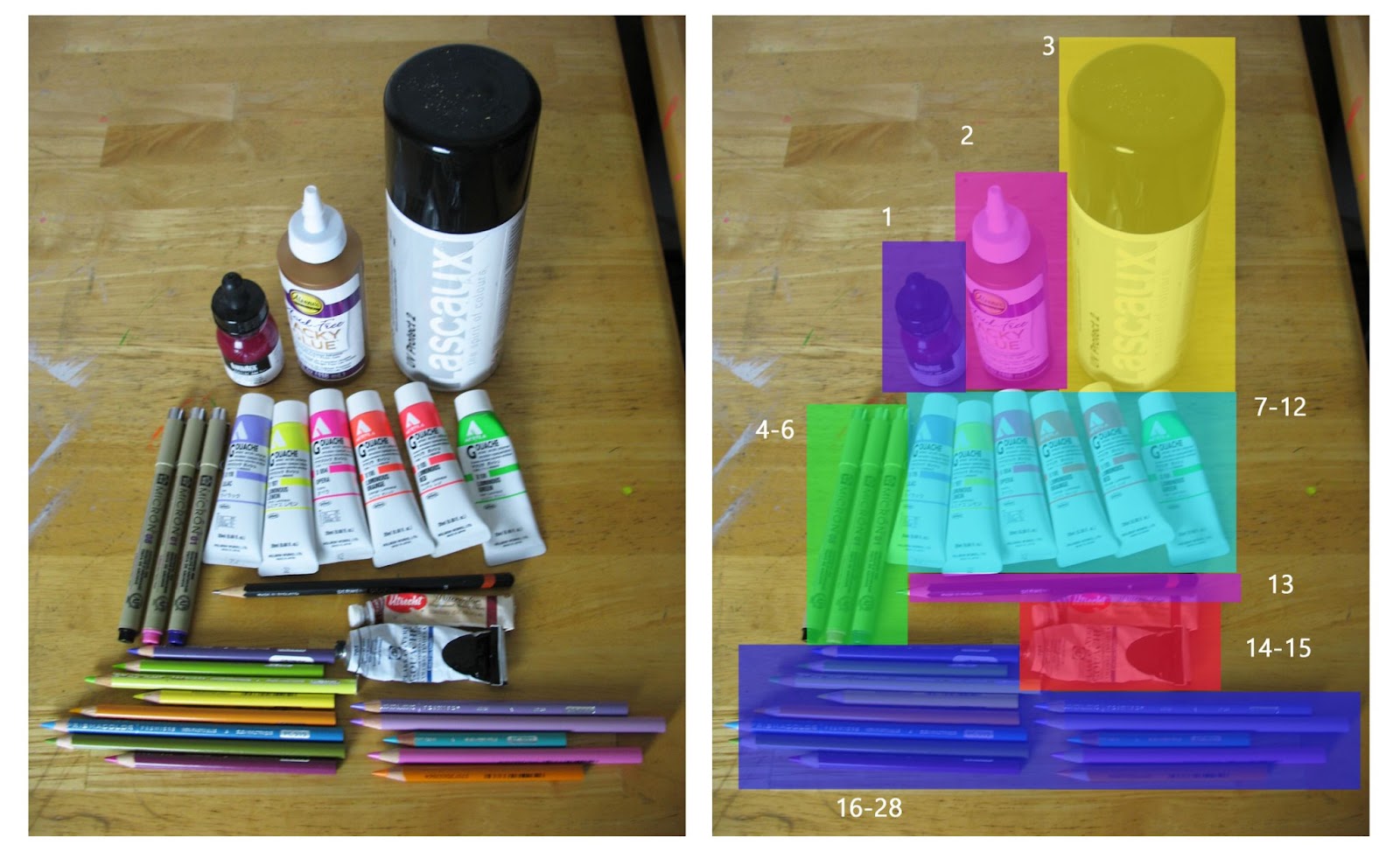
Here are the materials I used: 


  1. Liquitex Acrylic Ink (quinacridone magenta)

  2. Aleene’s Acid Free Tacky glue

  3. Lascaux UV Protect spray (matte)

  4. Micron Pigma Liner (black)

  5. Micron Pigma Liner (rose)

  6. Micron Pigma Liner (violet)

  7. Holbein Acryla Gouache paint (lilac)

  8. Holbein Acryla Gouache paint (luminous lemon)

  9. Holbein Acryla Gouache paint (opera)

  10. Holbein Acryla Gouache paint (luminous orange)

  11. Holbein Acryla Gouache paint (luminous red)

  12. Holbein Acryla Gouache paint (luminous green)

  13. Derwent graphite pencil

  14. Utrecht Watercolor (alizarin crimson)

  15. Talons Gouache (intense black)

16-28. Prismacolor colored pencils (left column, top to bottom) parma violet, chartreuse, yellow
            chartreuse, lemon yellow, spanish orange, non-photo blue, limepeel, process red

            (right column, top to bottom) lilac, lavender, light aqua, hot pink, yellow orange

***Paper used for all tests is Canson XL Bristol paper.*** 


Here are the test collages after their year of exposure:


No sun exposure (left) vs. Full sun exposure (right)


UV resistant plexi (left) vs. UV resistant spray (right)


No sun exposure (left) vs. UV resistant plexi with UV resistant spray (right)


Predictions:


  • Micron pen areas will come out the best (least fading). Prismacolor pencil swatches will be second best. Regular graphite will also do well.

  • Best result will be the collage protected by UV spray and UV resistant plexiglass, right?


Observations:


  • I was surprised by the amount of fading in the bottom row of colored pencil swatches, especially in the lilac and lavender colors. 

  • Gouache and watercolor that were applied opaquely did well. Pigments applied as a wash faded A LOT, regardless of their level of UV protection (best shown by the red rectangle placed in the bottom left corner of all of the collages).

  • The Lascaux spray didn’t seem to provide any extra protection (when compared head to head vs. the UV resistant plexi), AND it created a hazy cast on the black Micron areas of collages (you can see this in the black and white striped pieces near the middle of each collage) and also on the bottom right burgundy rectangles (mixture of watercolor and black gouache). Could this be the result of the matte finish? There are also semi-matte and gloss versions available. Is the one I got just funky? Based on this experience, I would not recommend it, but online reviews seem positive.

  • BEST outcome (besides no sun exposure): collage protected by UV resistant plexiglass, for the win! It had some fading, but not fading along with hazy areas caused by the Lascaux spray. 


It is good to see real proof that UV resistant plexi is protective of the types of materials I usually use. Going forward, I will continue to include it in frames, and I will also try to avoid washy/thin areas of pigment.


Of course, the best protection for works on paper is always to keep them away from sunlight and fluorescent lighting.


Do you have any best practices for protecting works on paper? Have you had a better experience with UV protective spray? Please feel free to share in the comments.


Monday, January 29, 2024

2023 Reflections (Nikki)

Studio sun

2023 was very much a back to basics year for me, as I experienced health issues that had me researching how to get back to a better (physical/mental) baseline. Because of this, the year's overall theme was maintaining new routines. These are lessons I learn and relearn: celebrate small wins, and small steps add up. I feel hopeful that 2024 will be a great year due to changes I made in 2023.

In no particular order, five things that sustained me in the past year:


*Health changes- getting sunlight first thing in the morning, eating more, eating regularly, eating less processed food, eating more protein, going to bed earlier, strength training, getting outside more


*Reading before bed- I look forward to this so much, as it’s become part of my routine and helps me wind down. Favorite books of the year: Tomorrow and Tomorrow and Tomorrow by Gabrielle Zevin, the My Brilliant Friend trilogy by Elena Ferrante, and for art/creativity-related books: The Creative Act by Rick Rubin


*Working consistently in the studio- not a change, just something that continues to be a mainstay for many reasons


*Looking for free opportunities- paying to apply for opportunities has always been something I accepted as part of getting my work in front of new eyes, but I decided to take a break from it for most of 2023. Fortunately, I was asked to participate in shows by friends and past connections, in addition to finding free opportunities. As a professional experiment, this reminded me that I can be selective about opportunities, without feeling nervous about gaps on my CV. I’d like to continue this through 2024, but we’ll see how it goes


*Less time on social media


*And a bonus thing- easy gluten-free pumpkin muffins:


Box of King Arthur’s gluten free muffin mix- follow the directions on the box, but skip the milk and add: 15 oz. can pumpkin, 3 tsp pumpkin pie spice. Use an electric mixer or electric hand mixer to make sure ingredients are thoroughly combined


I have been making these since October and love them for all year round.


Cheers to the new year!


Tuesday, October 31, 2023

Beating a Block


I recently had conversations with some artist friends about how we defeat that dreaded state artists (and creatives) feel at least once in their lives. We were discussing how to get out of a block.


Being “blocked” is interesting in that it’s something only you can determine applies to you. I might think of someone that hasn’t made work in years as being blocked, but they might describe themselves as simply taking a break. You know it if you’re in it, that strange frozen feeling that happens when you just can’t make work. 


Of course, you CAN do it. A block doesn’t refer to the physical inability to make things; instead, it refers to a mental block or a mindset that results in not taking action. Being blocked is being stuck, and ending a block requires the decision followed by the actions taken towards making. It sounds simple, but somehow, it's not.


Our conversations defined some must-haves for beating a block:


Material concerns- These run the gamut from having things necessary to make your work, to having a space that fosters your practice. I’ve tricked myself out of blocks a few times by purchasing new materials (the feeling that I’ve spent money, so now I can’t “waste” it by not working has spurred me to action). 


At other times, I’ve exited a block by cleaning up my workspace. Knowing that my space is tidy and ready to get filled up with new work is motivating.


Work redefined- When we experience a block, it is helpful to rethink our definition of “work.” 


Once, after I hadn’t been in the studio for what felt like eons (it might have actually been two weeks), I convinced myself to get back in there by saying “You don’t even have to work, just spend 10 minutes getting ready to work,” and then I did tasks like reorganizing paper and pens, printing out calendars for the months ahead, and so on. Tasks we don’t think of as the actual work (other examples: cutting down paper, cleaning out a sink, researching opportunities, etc.), ARE in fact work, and some part of our brain recognizes this. We can use these small steps to shift a blocked mind closer to one that is ready for flow and ready for creating.


Time- Small time periods are important. When I’ve been away from working, getting back to it has felt like coming back to a sport: I remember how to do it, but I don’t have the same endurance level. I need to condition myself with smaller time periods of work to get back to the place where I can focus and work for hours on end. Usually it comes back quickly. Even though I tell myself I only need to do tasks (or work) for 10 minutes, 10 minutes easily stretches to half an hour, which soon becomes an hour, and so on. 


I have also gone through periods where I felt that, “Oh, I can’t do ANYTHING unless I have at least an hour!” But if you’ve been blocked for a while, 10 minutes a day for 2 weeks adds up to much more than 0 minutes a day for two weeks. You can do a lot with 10 minutes. 


Picking up the threads- Possibly the most complex piece of beating a block, because it’s so specific to the path you have been on in your work, “picking up the threads” refers to how you decide what you’re going to make. The ‘threads’ of what you make next will have some relationship to the work you’ve already made- whether you want to continue with familiar ideas and materials, or whether you want to diverge from what you’ve been doing.


In 2019, I needed to focus the work I was making. I was dealing with what felt like a very heavy block because I felt overwhelmed by the various paths my work had taken (I was working on at least 5 different bodies of work). Someone else might experience a block because they need to expand their practice and try something new. Ultimately, you are the only one who can pick up the thread of what needs to happen next in your practice.


Picking up the threads is so important, because once you’ve chosen what you are going to make, your excitement and desire to see your new work realized and out in the world may be all it takes to beat your block. 


But what if it’s not?


Being blocked can be the result of issues beyond not knowing what to make: depression or other mental health challenges, grieving, illness, life changes, and so on. In the case where you have all of the pieces in place: the materials, the time, the ideas for new work, but you still feel unable to take the step to make work, it’s okay to go easy on yourself and accept that your blocked state may actually be a signal from your unconscious that you need to take a break. 


This was also true of me in 2019. I had been working so hard the previous couple of years towards what (for me) was a massive show, and instead of taking time to rest and celebrate the work I had done, I immediately jumped to worrying about what I would make next and whether it would align with some imagined, collective expectations of me. I wish I had spent less time worrying and thinking about the future and more time being present, feeling proud of the work I had just accomplished. 


We think of being blocked as a problem to solve as soon as possible. In cases when this is true (hello, deadlines), hopefully the above thoughts can help you get back to work.


And if you have the opportunity, examine whether your block is a signal from your subconscious that you need something different, like more time to rest, or to follow a new direction with your work.


Blocks happen. Creativity and productivity are not meant to be sustained all hours of every day, 365 days of every year.


Sometimes a block is a block, and sometimes it is a sign that it’s time for a change. 


How have you beat a creative block? Please share in the comments!


Thursday, August 31, 2023

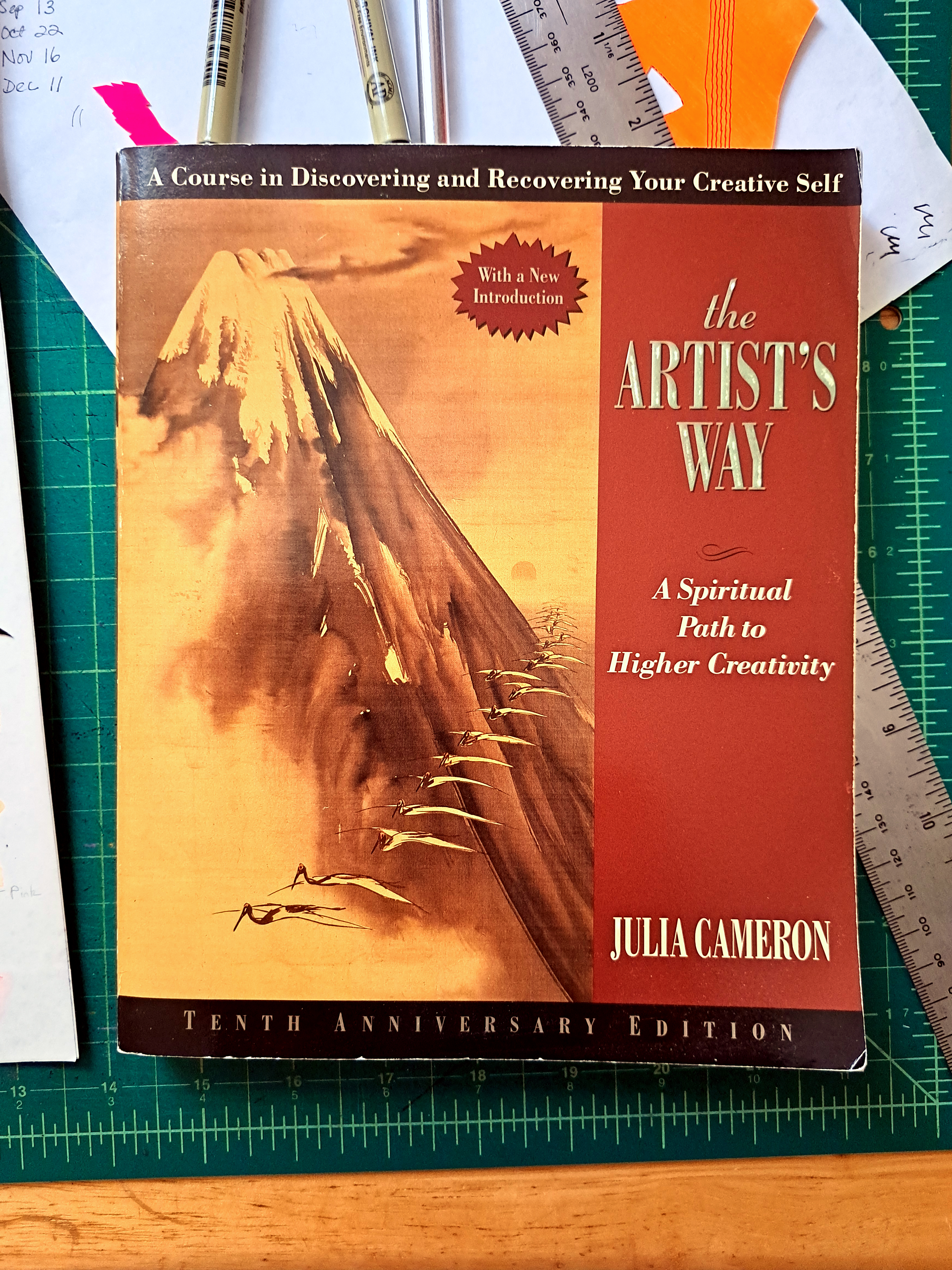
The Artist's Way: A Group Book Review


Katherine's copy of The Artist's Way by Julia Cameron with her journals full of Morning Pages

*How did we decide to do The Artist’s Way as a group?

Lauren: My memory is that I may have brought it up during one of our meetings. I noticed several groups of artists on Instagram working through the book together during the early Covid era in 2020-2021. I had also read about it in Carol Bove’s essay The Four-Hour Art Week: Read Carol Bove’s Self Help Guide for Artists from Akademie X. If Carol Bove was into it, how bad could it be? I may be wrong, but I think we started discussing it before Brian and I moved into our new house. Nikki you mentioned you had done it in the past. I think it took us a while to start, because we were in the new house when we began (November 2021?). We were all a little reluctant, I think.


Katherine: Yes - I agree with Lauren! I remember someone bringing it up in one of our monthly Zoom’s. I can’t remember if it was Nikki or Lauren, but I know that I was the only one who had never heard of it before.


Nikki: This is how I remember it too, and I think I was slightly pro- reading it, because I had also recently noticed some people posting about it on Instagram. But I also felt reluctant because I wasn’t sure I was ready to tackle Morning Pages again. But I thought it would be fun to read it with Lauren and Katherine! 


*What were your expectations or hopes going into reading the book?


N: I had read the book before, and actually felt like it led to my decision to quit a public school teaching job and apply to grad school… In some ways it feels like I owe my whole career to The Artist’s Way, so I definitely felt like big things could happen from re-reading it. I was also apprehensive, because I had tried to re-read it a second time previously and just couldn’t deal with the Morning Pages, so I felt worried I might have to (or might want to) tap out at some point.


L: I have no idea what I was expecting! I had the impression that I didn’t need the book, that it was all about being blocked as an artist. As an artist who rarely has been blocked, I doubted that it would be helpful at all. I did think that it might be helpful to share with students in the future, so I initially conceived of it as a teaching tool.


K: Lauren’s recollection about us being reluctant to start the book is spot-on. I had MANY reservations about this endeavor - it just felt like such a huge undertaking. I’m not a morning person, and I’d sworn off journaling in my early 20’s after realizing that I was just wallowing in my misery, and it made my life worse, not better. BUT - I trust Nikki and Lauren, and in the 2020 mindset I was really looking forward to doing something together as a group. My only hope was to just get through the book. I secretly gave myself permission to quit the morning journaling if it started bumming me out (sorry guys!). Spoiler alert: I’m SO GLAD I did it. The experience was every bit as transformative as everyone says it is, and I was definitely a skeptical/tough customer.


  Lauren's copy of The Artist's Way


*How would you describe The Artist’s Way to someone who hasn’t heard of it?


L: A guidebook for cultivating and supporting creativity. Full of lots of practical guidance, tactics, questions, observations and rules! But it’s more than that. It’s a spiritual experience. I just noticed that Julia Cameron refers to it as a “sourcebook”! That works!


K: I would say that The Artist’s Way is a program that helps you discover, confront, and ultimately dispel whatever biases you have about yourself and your artwork. It’ll help you clear the air in your own head, so you can get down to the business of practicing your art.


N: The Artist’s Way is a book that contains exercises focused on creativity. It’s not just like ‘let’s make something’, though. It's more meta in the way it approaches creativity, because it asks you to consider certain attitudes that affect how you approach creativity and how you can remove roadblocks in order to freely create. It directs you to think about how you think about creativity.


*What did you like most about reading the book (and why)?


L: It pushed me out of my element! I liked this, but it wasn’t always comfortable!


Prior to starting the book, my studio practice already felt expansive. With The Artist’s Way as a guide, I opened up to other art-adjacent areas that I have been interested in but never really wholeheartedly pursued. For instance, writing about art. Not only did I not feel particularly confident about my writing, I felt that pursuing writing would be a distraction from my so-called “real” work in the studio. The Artist’s Way helped me to see that both are intertwined and do not have to be mutually exclusive. At the risk of sounding like a really slow learner, I finally realized that I do not need anyone’s permission to write about art, that I could write how I wanted, I could write about anything I wanted and I could be inconsistent, silly, weird, and so on. 


Another important focus was the process of defining “success” for myself. Similar to my earlier thoughts on writing, I think my initial definition of “success” revolved around other artists, curators, critics, gallerists, etc. responses to my work. The book helped me to find the edges of my own, personal definition. Finishing the book actually felt like the beginning of the path–doing the book was kind of this odd, intermediary metamorphosis phase where lots of new ideas were just beginning to bubble to the surface.  I am still working on a personal definition of success, but this process has been pretty profound and reinvigorating for my artistic practice and my outlook on life as a whole.


K: I was surprised to find that I loved writing the morning pages, and am still doing them (almost) daily! I’ve written more about my experience with morning pages here.


N: Each time I have read the book, Julia Cameron’s compassion towards creatives has stood out, and so has the way she encourages us to be kinder to ourselves. The first time I read it, I was struck by the section about the ‘Inner Critic’, and how (according to Cameron) this mean monster way of treating ourselves and our work didn’t have to be something we keep doing. The information is just as poignant now, as I still have to work on separating from my Inner Critic, and I probably always will. 


Lauren's The Artist's Way and her Morning Pages journals


*What did you like least about reading the book (and why)?


L: One of the hardest parts for me were the affirmations. I didn’t feel like I got much out of them, but I think I may not be taking them seriously enough. I thought that writing every morning would be the hardest component, but I really got into the morning pages. In fact, I still write three pages every morning.


If I’m being honest, artist dates were also a major challenge for me. I love the idea of artist dates, but found them really hard to fit into my schedule between teaching, the studio, parenting and having a life. It was really challenging to give myself that time! I did do the artist dates every week, but they were pretty tame.  If I did the book again, I would push the adventurousness of my artist dates.


K: I agree with Lauren - the affirmations were tough for me. I really tried hard, but they just felt silly, and like I was trying to affirm things that were ultimately out of my control. I quit doing them.


N: Morning Pages were/are a tough commitment for me, because I often feel impatient and like I am wasting time while writing them. The second time I tried to read/do the book, I quit because I didn’t want to do Morning Pages, and I didn’t feel right about reading the book without also doing the exercises. I’ve gotten around that this time by being more flexible with my expectations for the writing (instead of doing 3 pages, I do one, I usually don't write on weekends, I don’t always write in the morning, etc.). I know I’m not getting some of the intended value by not writing the full 3 pages, but I am still getting something important from them by developing a strong relationship with my inner voice. 


Artist Dates are also tough, but for some reason I’m not as hard on myself about not getting those in each week as I am about the writing. Maybe because since they seem fun, I don’t feel guilty when I miss them. This definitely says something about internalized ideals and expectations around “work” versus “play”... something to think about.


*How did the book change the way you think about your work or yourself?


L: I think it changed the way I think about myself, more so than my work. That’s really what I needed, a way to feel more confident in myself even if I was not getting outside reinforcement. It helped me to develop a more nurturing inner voice, as well as develop more constructive relationships to success, work and time.


K: The book really changed the way I view my artistic practice in relation to other parts of my life. I have a lot of other responsibilities and interests, and I used to feel guilty about not spending enough time in the studio, especially whenever I was ‘indulging’ in something for fun, vs work or family obligations. Completing The Artist’s Way helped me find peace around all of this. Not only do I feel a lot less guilty about pursuing these other interests, but I’ve come to view my wide ranging skill set as something of a super power, and am now looking for ways of folding these skills and interests into my studio practice. The Artist’s Way helped me feel like a whole person, instead of feeling like my attention was constantly being pulled in different directions.


N: Detaching from my Inner Critic, was (and is) a really big deal for me. 


Acknowledging the importance of play in the creative process via Artist Dates has also helped me follow different routes in the studio and take time to consider ideas that might otherwise have seemed like sidetracks. 


The Artist’s Way was the first authoritative voice for me that said it was good to embrace the things you love and that bring pleasure and joy (in making your work), and that it’s okay to enjoy these things without having to rationalize and verbalize the meaning of it all. 


Looking for synchronicities every week and every day has also become important thanks to The Artist’s Way. It feels like a different, more magical take on a gratitude practice.


Nikki's copy


*Who would you recommend this book to? What do they need to know before they start?


L: I’d recommend this book to art students, people who think that they’re not creative, all artists/creatives, even people that think they don’t need it. Maybe everyone needs this book?!


Follow the rules! Do the hard questions/tasks (I’m 100% talking to myself here, as I bent a lot of the rules and tried to avoid some questions and prompts that I didn’t want to answer).


K: Honestly, I think this book would be perfect for anyone with big goals, whether or not they’re art related. The book’s real power is helping the reader create structure and discipline that are tailored to their life, and therefore easier to maintain long-term, but it takes work. I would advise anyone considering this book to be sure to give it enough time - at least 30 minutes to an hour of writing each day (sometimes more), and several more hours each week for reading and Artist Dates. I was really grateful to have started it over Winter Break, so I could get used to the routine before my spring classes started.


N: I would recommend the book to any artist, and anyone who engages thoughtfully with the creative act. You will get out of it in direct proportion to the effort you put in. AND if you can go through it with a small group of creative people who are serious about it, and who will do the weekly check-ins, your experience will be enriched, because learning how The Artist’s Way is working for others will help you see better the ways it’s working for you too. It is great to do the book by yourself, it’s incredibly valuable either way, but if you can read and share about it with people you trust, the experience will be richer. 


I am not being hyperbolic in saying the book has changed my life each of the times I have read it, and I am so grateful to Lauren and Katherine for being part of that this time around.


*Will you read/do The Artist’s Way again? Why/why not? If yes, when?


N: I will do The Artist’s Way again, but I don’t know when. I’ve (mostly- I took a break for 2 weeks) continued the practice of the Morning Pages since completing it this last time, but I allow myself to do a daily (on weekdays) abbreviated version (about a page) in order to keep it going. It’s been a useful practice to check in with myself and get grounded. Every time I’ve undertaken The Artist’s Way (except for the first time when I didn’t know what to expect), I’ve felt apprehension and dread about committing to the Morning Pages all over again, and I think I would still feel this way coming back to it for a fourth time. I don’t know why they feel like such a hurdle, BUT I also feel excited about when it will seem like the right time to do the book again. 


L: I will definitely do it again. I’ve also continued to write morning pages and check-in weekly with Nikki and Katherine. I have also periodically looked back through the book, when I’ve felt like I needed a reminder.


I don’t know when, but I have a feeling that I will go through the entire book again, at some point!


K: The Artist’s Way still feels so present, it’s hard to imagine doing it again! But I could see myself doing it the next time I feel stuck.  I’m currently working towards a show next year. It’ll be my biggest solo show so far(!!) and I definitely would not have landed without doing The Artist’s Way, and Nikki and Lauren’s support! The last time I completed a big project, I felt stuck and directionless for about a year. I would definitely consider doing The Artist’s Way if that happens again, but then again, the morning pages are helping to generate so many ideas that it may not happen this time. We’ll see!


Have you completed The Artist's Way? How was your experience? We would like to hear about it! Please share in the comments.


Short Answer Sunday: Katherine Knight

Welcome to Short Answer Sunday , an interview series where I ask artists, art adjacent individuals, and other interesting, creative people t...