Showing posts with label mindset. Show all posts

Wednesday, June 12, 2024

Reflecting on Rejection: Two Reasons We're Not Getting Into Juried Shows


When you submit work to a juried show and it gets declined, do you check out the show after it’s up (either online or in person)? Or is your attitude more along the lines of trying to forget about the rejection letter and moving on to other things?

For as long as I have been applying for shows, my feelings aligned with the latter, and I didn’t see much value in dwelling on what felt like missed opportunities. In the last couple of years, I’ve gotten curious about jurors’ and curators’ tastes and what work fits what they’re looking for, and why my work sometimes has not.


Assuming that we are meeting the basic entry requirements for a show (providing excellent images of strong work, fitting our statements into word count limits, etc.), there are two main reasons I’ve noticed for why my (and probably also your own) work hasn’t been included in juried shows. One of them may surprise you.


The least surprising reason for a rejection: the work doesn’t fit with the whole of the show. This can be a case of “the juror just didn’t like it,” but it can also be more subtle, relating to slight formal or conceptual mismatches. One of the first things I look for when I am trying to figure out why my work didn’t get into a show is the exhibition’s overall formal vibe; often, my colorful, graphic work presents a glaring contrast to a group of work that has softer edges or more muted colors. 


Conceptual mismatches can be harder to pinpoint, and if a juror provides a statement about their selections, this is helpful. I recently submitted work that was declined from a ‘nature’ themed show, and even after reading the juror’s statement and viewing the accepted work, I was struggling to determine why my work was not a fit. I was about to chalk it up to “they just didn’t like it,” (which may also have been the case) when I finally realized that all of the works in the show were speaking to broader topics relating to the natural world, like climate change, sustainability, etc., while my work instead presents a quirky microcosm that is more about a single moment in time. 


After I realized this, it seemed obvious, but it can be difficult to consider our work objectively. This kind of thinking is valuable, because considering why our work isn’t included in a show can point us towards contexts that will be a better fit.


A more surprising reason for our work’s rejection from a show: our work is already in the show. By this, I mean there is work included in the show that is visually very similar to ours. “Very” is subjective and sometimes hard to determine because we are able to attune to all the ways our work stands out that may not be as apparent to a juror, especially when they have just viewed 599 other applications. In this case, there may also be something else in the application packet that gives the selected work a leg up. For example, if CV’s are part of the application requirements, the selected artist’s CV may be more developed than our own.


This happened to me several years ago, when I noted in a group show I had been rejected from work that, like my own, was very colorful, with graphic edges and lots of patterns. However, I knew this artist’s name and was even familiar with curatorial projects they had developed. It was easy to see that while my work might have filled the same visual slot as this artist’s, their more prestigious CV could add value to the group exhibition in a way that mine could not.


It is always disappointing to get a rejection letter for an opportunity that we want, but if we take the time to consider the larger picture of where our work fits (or doesn’t) and why, we may* be able to pick better suited opportunities going forward. 


*To some degree, applying for things is always a roll of the dice. But we only have a chance at getting the things that we do apply for.


Tuesday, October 31, 2023

Beating a Block


I recently had conversations with some artist friends about how we defeat that dreaded state artists (and creatives) feel at least once in their lives. We were discussing how to get out of a block.


Being “blocked” is interesting in that it’s something only you can determine applies to you. I might think of someone that hasn’t made work in years as being blocked, but they might describe themselves as simply taking a break. You know it if you’re in it, that strange frozen feeling that happens when you just can’t make work. 


Of course, you CAN do it. A block doesn’t refer to the physical inability to make things; instead, it refers to a mental block or a mindset that results in not taking action. Being blocked is being stuck, and ending a block requires the decision followed by the actions taken towards making. It sounds simple, but somehow, it's not.


Our conversations defined some must-haves for beating a block:


Material concerns- These run the gamut from having things necessary to make your work, to having a space that fosters your practice. I’ve tricked myself out of blocks a few times by purchasing new materials (the feeling that I’ve spent money, so now I can’t “waste” it by not working has spurred me to action). 


At other times, I’ve exited a block by cleaning up my workspace. Knowing that my space is tidy and ready to get filled up with new work is motivating.


Work redefined- When we experience a block, it is helpful to rethink our definition of “work.” 


Once, after I hadn’t been in the studio for what felt like eons (it might have actually been two weeks), I convinced myself to get back in there by saying “You don’t even have to work, just spend 10 minutes getting ready to work,” and then I did tasks like reorganizing paper and pens, printing out calendars for the months ahead, and so on. Tasks we don’t think of as the actual work (other examples: cutting down paper, cleaning out a sink, researching opportunities, etc.), ARE in fact work, and some part of our brain recognizes this. We can use these small steps to shift a blocked mind closer to one that is ready for flow and ready for creating.


Time- Small time periods are important. When I’ve been away from working, getting back to it has felt like coming back to a sport: I remember how to do it, but I don’t have the same endurance level. I need to condition myself with smaller time periods of work to get back to the place where I can focus and work for hours on end. Usually it comes back quickly. Even though I tell myself I only need to do tasks (or work) for 10 minutes, 10 minutes easily stretches to half an hour, which soon becomes an hour, and so on. 


I have also gone through periods where I felt that, “Oh, I can’t do ANYTHING unless I have at least an hour!” But if you’ve been blocked for a while, 10 minutes a day for 2 weeks adds up to much more than 0 minutes a day for two weeks. You can do a lot with 10 minutes. 


Picking up the threads- Possibly the most complex piece of beating a block, because it’s so specific to the path you have been on in your work, “picking up the threads” refers to how you decide what you’re going to make. The ‘threads’ of what you make next will have some relationship to the work you’ve already made- whether you want to continue with familiar ideas and materials, or whether you want to diverge from what you’ve been doing.


In 2019, I needed to focus the work I was making. I was dealing with what felt like a very heavy block because I felt overwhelmed by the various paths my work had taken (I was working on at least 5 different bodies of work). Someone else might experience a block because they need to expand their practice and try something new. Ultimately, you are the only one who can pick up the thread of what needs to happen next in your practice.


Picking up the threads is so important, because once you’ve chosen what you are going to make, your excitement and desire to see your new work realized and out in the world may be all it takes to beat your block. 


But what if it’s not?


Being blocked can be the result of issues beyond not knowing what to make: depression or other mental health challenges, grieving, illness, life changes, and so on. In the case where you have all of the pieces in place: the materials, the time, the ideas for new work, but you still feel unable to take the step to make work, it’s okay to go easy on yourself and accept that your blocked state may actually be a signal from your unconscious that you need to take a break. 


This was also true of me in 2019. I had been working so hard the previous couple of years towards what (for me) was a massive show, and instead of taking time to rest and celebrate the work I had done, I immediately jumped to worrying about what I would make next and whether it would align with some imagined, collective expectations of me. I wish I had spent less time worrying and thinking about the future and more time being present, feeling proud of the work I had just accomplished. 


We think of being blocked as a problem to solve as soon as possible. In cases when this is true (hello, deadlines), hopefully the above thoughts can help you get back to work.


And if you have the opportunity, examine whether your block is a signal from your subconscious that you need something different, like more time to rest, or to follow a new direction with your work.


Blocks happen. Creativity and productivity are not meant to be sustained all hours of every day, 365 days of every year.


Sometimes a block is a block, and sometimes it is a sign that it’s time for a change. 


How have you beat a creative block? Please share in the comments!


Thursday, August 31, 2023

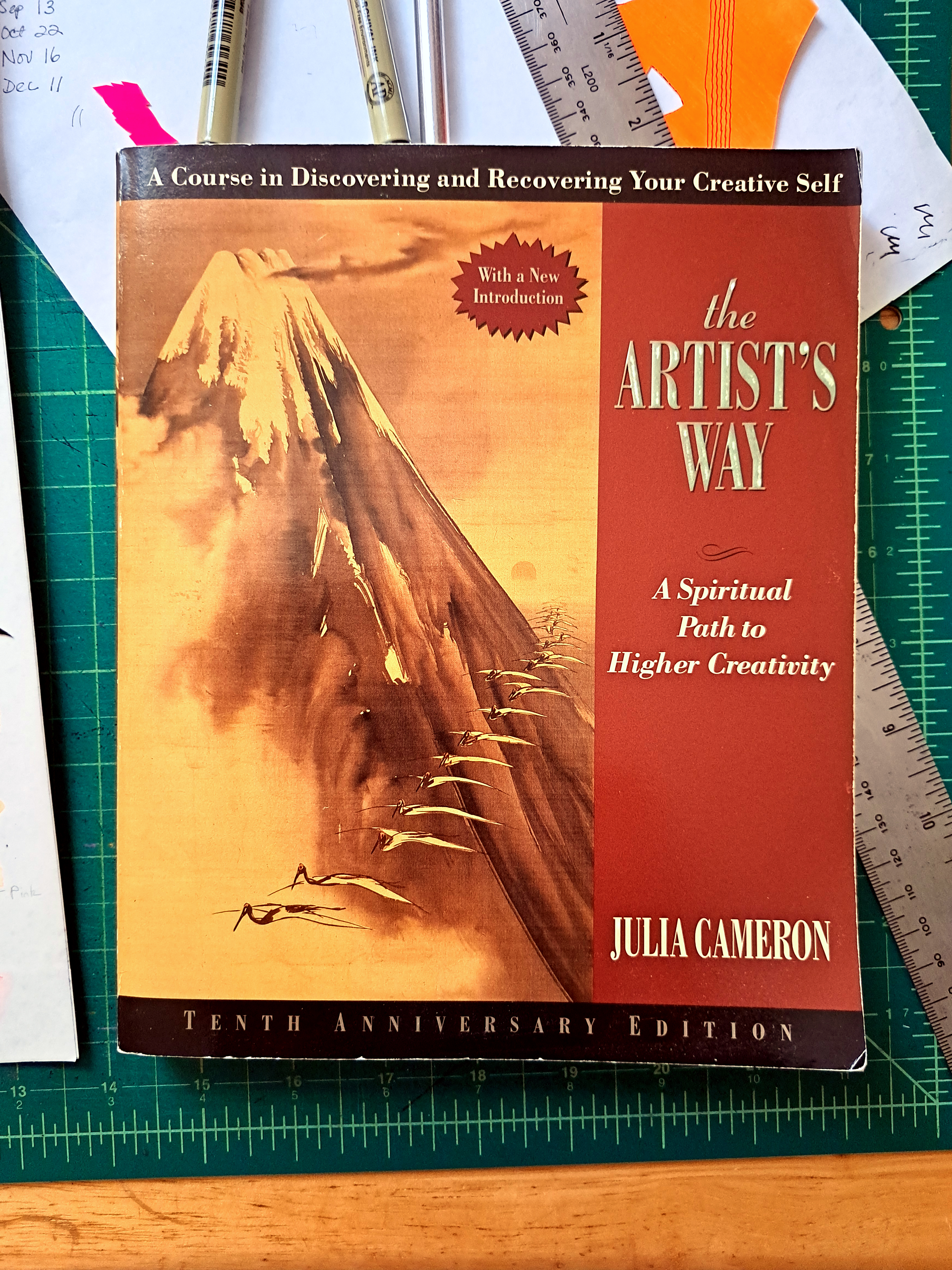
The Artist's Way: A Group Book Review


Katherine's copy of The Artist's Way by Julia Cameron with her journals full of Morning Pages

*How did we decide to do The Artist’s Way as a group?

Lauren: My memory is that I may have brought it up during one of our meetings. I noticed several groups of artists on Instagram working through the book together during the early Covid era in 2020-2021. I had also read about it in Carol Bove’s essay The Four-Hour Art Week: Read Carol Bove’s Self Help Guide for Artists from Akademie X. If Carol Bove was into it, how bad could it be? I may be wrong, but I think we started discussing it before Brian and I moved into our new house. Nikki you mentioned you had done it in the past. I think it took us a while to start, because we were in the new house when we began (November 2021?). We were all a little reluctant, I think.


Katherine: Yes - I agree with Lauren! I remember someone bringing it up in one of our monthly Zoom’s. I can’t remember if it was Nikki or Lauren, but I know that I was the only one who had never heard of it before.


Nikki: This is how I remember it too, and I think I was slightly pro- reading it, because I had also recently noticed some people posting about it on Instagram. But I also felt reluctant because I wasn’t sure I was ready to tackle Morning Pages again. But I thought it would be fun to read it with Lauren and Katherine! 


*What were your expectations or hopes going into reading the book?


N: I had read the book before, and actually felt like it led to my decision to quit a public school teaching job and apply to grad school… In some ways it feels like I owe my whole career to The Artist’s Way, so I definitely felt like big things could happen from re-reading it. I was also apprehensive, because I had tried to re-read it a second time previously and just couldn’t deal with the Morning Pages, so I felt worried I might have to (or might want to) tap out at some point.


L: I have no idea what I was expecting! I had the impression that I didn’t need the book, that it was all about being blocked as an artist. As an artist who rarely has been blocked, I doubted that it would be helpful at all. I did think that it might be helpful to share with students in the future, so I initially conceived of it as a teaching tool.


K: Lauren’s recollection about us being reluctant to start the book is spot-on. I had MANY reservations about this endeavor - it just felt like such a huge undertaking. I’m not a morning person, and I’d sworn off journaling in my early 20’s after realizing that I was just wallowing in my misery, and it made my life worse, not better. BUT - I trust Nikki and Lauren, and in the 2020 mindset I was really looking forward to doing something together as a group. My only hope was to just get through the book. I secretly gave myself permission to quit the morning journaling if it started bumming me out (sorry guys!). Spoiler alert: I’m SO GLAD I did it. The experience was every bit as transformative as everyone says it is, and I was definitely a skeptical/tough customer.


  Lauren's copy of The Artist's Way


*How would you describe The Artist’s Way to someone who hasn’t heard of it?


L: A guidebook for cultivating and supporting creativity. Full of lots of practical guidance, tactics, questions, observations and rules! But it’s more than that. It’s a spiritual experience. I just noticed that Julia Cameron refers to it as a “sourcebook”! That works!


K: I would say that The Artist’s Way is a program that helps you discover, confront, and ultimately dispel whatever biases you have about yourself and your artwork. It’ll help you clear the air in your own head, so you can get down to the business of practicing your art.


N: The Artist’s Way is a book that contains exercises focused on creativity. It’s not just like ‘let’s make something’, though. It's more meta in the way it approaches creativity, because it asks you to consider certain attitudes that affect how you approach creativity and how you can remove roadblocks in order to freely create. It directs you to think about how you think about creativity.


*What did you like most about reading the book (and why)?


L: It pushed me out of my element! I liked this, but it wasn’t always comfortable!


Prior to starting the book, my studio practice already felt expansive. With The Artist’s Way as a guide, I opened up to other art-adjacent areas that I have been interested in but never really wholeheartedly pursued. For instance, writing about art. Not only did I not feel particularly confident about my writing, I felt that pursuing writing would be a distraction from my so-called “real” work in the studio. The Artist’s Way helped me to see that both are intertwined and do not have to be mutually exclusive. At the risk of sounding like a really slow learner, I finally realized that I do not need anyone’s permission to write about art, that I could write how I wanted, I could write about anything I wanted and I could be inconsistent, silly, weird, and so on. 


Another important focus was the process of defining “success” for myself. Similar to my earlier thoughts on writing, I think my initial definition of “success” revolved around other artists, curators, critics, gallerists, etc. responses to my work. The book helped me to find the edges of my own, personal definition. Finishing the book actually felt like the beginning of the path–doing the book was kind of this odd, intermediary metamorphosis phase where lots of new ideas were just beginning to bubble to the surface.  I am still working on a personal definition of success, but this process has been pretty profound and reinvigorating for my artistic practice and my outlook on life as a whole.


K: I was surprised to find that I loved writing the morning pages, and am still doing them (almost) daily! I’ve written more about my experience with morning pages here.


N: Each time I have read the book, Julia Cameron’s compassion towards creatives has stood out, and so has the way she encourages us to be kinder to ourselves. The first time I read it, I was struck by the section about the ‘Inner Critic’, and how (according to Cameron) this mean monster way of treating ourselves and our work didn’t have to be something we keep doing. The information is just as poignant now, as I still have to work on separating from my Inner Critic, and I probably always will. 


Lauren's The Artist's Way and her Morning Pages journals


*What did you like least about reading the book (and why)?


L: One of the hardest parts for me were the affirmations. I didn’t feel like I got much out of them, but I think I may not be taking them seriously enough. I thought that writing every morning would be the hardest component, but I really got into the morning pages. In fact, I still write three pages every morning.


If I’m being honest, artist dates were also a major challenge for me. I love the idea of artist dates, but found them really hard to fit into my schedule between teaching, the studio, parenting and having a life. It was really challenging to give myself that time! I did do the artist dates every week, but they were pretty tame.  If I did the book again, I would push the adventurousness of my artist dates.


K: I agree with Lauren - the affirmations were tough for me. I really tried hard, but they just felt silly, and like I was trying to affirm things that were ultimately out of my control. I quit doing them.


N: Morning Pages were/are a tough commitment for me, because I often feel impatient and like I am wasting time while writing them. The second time I tried to read/do the book, I quit because I didn’t want to do Morning Pages, and I didn’t feel right about reading the book without also doing the exercises. I’ve gotten around that this time by being more flexible with my expectations for the writing (instead of doing 3 pages, I do one, I usually don't write on weekends, I don’t always write in the morning, etc.). I know I’m not getting some of the intended value by not writing the full 3 pages, but I am still getting something important from them by developing a strong relationship with my inner voice. 


Artist Dates are also tough, but for some reason I’m not as hard on myself about not getting those in each week as I am about the writing. Maybe because since they seem fun, I don’t feel guilty when I miss them. This definitely says something about internalized ideals and expectations around “work” versus “play”... something to think about.


*How did the book change the way you think about your work or yourself?


L: I think it changed the way I think about myself, more so than my work. That’s really what I needed, a way to feel more confident in myself even if I was not getting outside reinforcement. It helped me to develop a more nurturing inner voice, as well as develop more constructive relationships to success, work and time.


K: The book really changed the way I view my artistic practice in relation to other parts of my life. I have a lot of other responsibilities and interests, and I used to feel guilty about not spending enough time in the studio, especially whenever I was ‘indulging’ in something for fun, vs work or family obligations. Completing The Artist’s Way helped me find peace around all of this. Not only do I feel a lot less guilty about pursuing these other interests, but I’ve come to view my wide ranging skill set as something of a super power, and am now looking for ways of folding these skills and interests into my studio practice. The Artist’s Way helped me feel like a whole person, instead of feeling like my attention was constantly being pulled in different directions.


N: Detaching from my Inner Critic, was (and is) a really big deal for me. 


Acknowledging the importance of play in the creative process via Artist Dates has also helped me follow different routes in the studio and take time to consider ideas that might otherwise have seemed like sidetracks. 


The Artist’s Way was the first authoritative voice for me that said it was good to embrace the things you love and that bring pleasure and joy (in making your work), and that it’s okay to enjoy these things without having to rationalize and verbalize the meaning of it all. 


Looking for synchronicities every week and every day has also become important thanks to The Artist’s Way. It feels like a different, more magical take on a gratitude practice.


Nikki's copy


*Who would you recommend this book to? What do they need to know before they start?


L: I’d recommend this book to art students, people who think that they’re not creative, all artists/creatives, even people that think they don’t need it. Maybe everyone needs this book?!


Follow the rules! Do the hard questions/tasks (I’m 100% talking to myself here, as I bent a lot of the rules and tried to avoid some questions and prompts that I didn’t want to answer).


K: Honestly, I think this book would be perfect for anyone with big goals, whether or not they’re art related. The book’s real power is helping the reader create structure and discipline that are tailored to their life, and therefore easier to maintain long-term, but it takes work. I would advise anyone considering this book to be sure to give it enough time - at least 30 minutes to an hour of writing each day (sometimes more), and several more hours each week for reading and Artist Dates. I was really grateful to have started it over Winter Break, so I could get used to the routine before my spring classes started.


N: I would recommend the book to any artist, and anyone who engages thoughtfully with the creative act. You will get out of it in direct proportion to the effort you put in. AND if you can go through it with a small group of creative people who are serious about it, and who will do the weekly check-ins, your experience will be enriched, because learning how The Artist’s Way is working for others will help you see better the ways it’s working for you too. It is great to do the book by yourself, it’s incredibly valuable either way, but if you can read and share about it with people you trust, the experience will be richer. 


I am not being hyperbolic in saying the book has changed my life each of the times I have read it, and I am so grateful to Lauren and Katherine for being part of that this time around.


*Will you read/do The Artist’s Way again? Why/why not? If yes, when?


N: I will do The Artist’s Way again, but I don’t know when. I’ve (mostly- I took a break for 2 weeks) continued the practice of the Morning Pages since completing it this last time, but I allow myself to do a daily (on weekdays) abbreviated version (about a page) in order to keep it going. It’s been a useful practice to check in with myself and get grounded. Every time I’ve undertaken The Artist’s Way (except for the first time when I didn’t know what to expect), I’ve felt apprehension and dread about committing to the Morning Pages all over again, and I think I would still feel this way coming back to it for a fourth time. I don’t know why they feel like such a hurdle, BUT I also feel excited about when it will seem like the right time to do the book again. 


L: I will definitely do it again. I’ve also continued to write morning pages and check-in weekly with Nikki and Katherine. I have also periodically looked back through the book, when I’ve felt like I needed a reminder.


I don’t know when, but I have a feeling that I will go through the entire book again, at some point!


K: The Artist’s Way still feels so present, it’s hard to imagine doing it again! But I could see myself doing it the next time I feel stuck.  I’m currently working towards a show next year. It’ll be my biggest solo show so far(!!) and I definitely would not have landed without doing The Artist’s Way, and Nikki and Lauren’s support! The last time I completed a big project, I felt stuck and directionless for about a year. I would definitely consider doing The Artist’s Way if that happens again, but then again, the morning pages are helping to generate so many ideas that it may not happen this time. We’ll see!


Have you completed The Artist's Way? How was your experience? We would like to hear about it! Please share in the comments.


Saturday, May 13, 2023

Thoughts About Success


I recently read a review of a group exhibition, and the critic mentioned that in the time since making the work included in the show, some of the artists had “failed.” 


I had ideas about what the critic meant by that statement, but then I wondered what it meant to me. How does an artist fail? The main thing I could come up with was that to have failed, they would have given up on making work.* 


Around the same time I was also thinking about how we (artists) define success for ourselves.


We all have ideas about what it looks like. We see examples of success all the time, because it’s the main part of the job that’s public: the exhibitions, the awards, the publications…the lines on people’s CV’s. And there is social media, where we spotlight our success.

We know what success looks like for everyone else, but the most important thing we can do for ourselves is determining what success looks like for us. And we need to practice feeling successful in the present moment. 


 *This is not the same as taking a break from making work. Taking a break is not failure. But does the decision to give up discount all of the work an artist made prior to that decision? That doesn’t seem right.


A personal definition of success: considerations and goals


Possible considerations for defining what success looks like for us:


*Our work- does it excite us, does it challenge us, are we working to improve it, does it express our values?


*Our community- how are we showing up for others and providing opportunities or resources? Do we give more than we take?


*Our resources- what do we have space, finances, and mental/physical/emotional energy to realistically accomplish at this time?


When we consider these career components (or others), do we give ourselves related goals based on things we can control? If not, our goals for achieving success are based on external sources of validation (like shows, prizes, or anything where we have to be ‘picked’ by someone else), not solely on the work we are putting in.


As an example, a few years ago, I started the new year with several career goals. One was to apply for 3 opportunities per month. Another was to add 3 group shows to my CV for the year. The first of these goals I had infinitely more control over than the second, because having work included in shows relies on others’ curatorial decisions, but my submitting applications was a goal based on my own efforts. Some goals for achieving success are more valuable, because they acknowledge the amount of work we have done, not the way external sources perceive that work. 


When we recognize our own success based on the work we have put in, we are also practicing our ability to feel successful in the present moment.


Success in the present moment


If we want to pursue our career by seeking out external validation, we can absolutely do that. But what if the work we care most about making is never “in” during our lifetime? Or what if we never make the right connections to show in the right spaces? Do we choose to see ourselves as failures because external factors don’t work out in our favor?


During the last few years, growing awareness of ‘hustle culture’ has helped many of us consider how we treat ourselves around our perceived success (or lack thereof). We still have a long way to go.


One of the greatest successes we can have is an attitude of kindness towards ourselves. We can care about our goals and work at our highest level, while realizing that many things are out of our control. We can celebrate ourselves when we win and alternately, we can be satisfied in knowing that we did our best and will try again when our work is not chosen. We can choose our own version of success instead of waiting for The Art World to anoint us. 


My ideas about success have changed a lot over the last few years. When I think about something I want to achieve, I consider whether it really matters to me (and why), or whether it’s something I feel like I should do (in the best of scenarios, these overlap). For me, right now, success means I am treating myself with compassion and I am making work that I feel excited about. 


It’s been said that the only person we need to impress is ourselves at 17 and ourselves at 70. I agree with this, partly. Instead, I’d say that the only person I need to impress is me, right now. 17-year-old me had no idea what today-me would be dealing with, and I believe that 70-year-old me will feel proud knowing that today-me did the best that I could, even if I don’t achieve things the rest of the world considers big or important. 


Regardless, I, right now, am the only version of me that will ever exist, and in order for 70-year- old me to feel a sense of pride and achievement, I need to start practicing that for myself now.


Success, or feeling successful, is a practice, but not in the way we think. It is a feeling we must cultivate in the present moment, not one we should strive to have in the future.


Related quotes:


“You have the right to work, but for the work's sake only. You have no right to the fruits of work. Desire for the fruits of work must never be your motive in working. 

… Work done with anxiety about results is far inferior to work done without such anxiety, in the calm of self-surrender. .... They who work selfishly for results are miserable.”

-paraphrased from the Bhagavad Gita


“Success is not a goal, it’s a byproduct.”

                -Coach Taylor, Friday Night Lights


“Whether you succeed or not is irrelevant- there is no such thing. Making your unknown known is the important thing- and keeping the unknown always beyond you…”

-Georgia O’Keeffe

Short Answer Sunday: Katherine Knight

Welcome to Short Answer Sunday , an interview series where I ask artists, art adjacent individuals, and other interesting, creative people t...