Lauren: My memory is that I may have brought it up during one of our meetings. I noticed several groups of artists on Instagram working through the book together during the early Covid era in 2020-2021. I had also read about it in Carol Bove’s essay The Four-Hour Art Week: Read Carol Bove’s Self Help Guide for Artists from Akademie X. If Carol Bove was into it, how bad could it be? I may be wrong, but I think we started discussing it before Brian and I moved into our new house. Nikki you mentioned you had done it in the past. I think it took us a while to start, because we were in the new house when we began (November 2021?). We were all a little reluctant, I think.
Katherine: Yes - I agree with Lauren! I remember someone bringing it up in one of our monthly Zoom’s. I can’t remember if it was Nikki or Lauren, but I know that I was the only one who had never heard of it before.
Nikki: This is how I remember it too, and I think I was slightly pro- reading it, because I had also recently noticed some people posting about it on Instagram. But I also felt reluctant because I wasn’t sure I was ready to tackle Morning Pages again. But I thought it would be fun to read it with Lauren and Katherine!
*What were your expectations or hopes going into reading the book?
N: I had read the book before, and actually felt like it led to my decision to quit a public school teaching job and apply to grad school… In some ways it feels like I owe my whole career to The Artist’s Way, so I definitely felt like big things could happen from re-reading it. I was also apprehensive, because I had tried to re-read it a second time previously and just couldn’t deal with the Morning Pages, so I felt worried I might have to (or might want to) tap out at some point.
L: I have no idea what I was expecting! I had the impression that I didn’t need the book, that it was all about being blocked as an artist. As an artist who rarely has been blocked, I doubted that it would be helpful at all. I did think that it might be helpful to share with students in the future, so I initially conceived of it as a teaching tool.
K: Lauren’s recollection about us being reluctant to start the book is spot-on. I had MANY reservations about this endeavor - it just felt like such a huge undertaking. I’m not a morning person, and I’d sworn off journaling in my early 20’s after realizing that I was just wallowing in my misery, and it made my life worse, not better. BUT - I trust Nikki and Lauren, and in the 2020 mindset I was really looking forward to doing something together as a group. My only hope was to just get through the book. I secretly gave myself permission to quit the morning journaling if it started bumming me out (sorry guys!). Spoiler alert: I’m SO GLAD I did it. The experience was every bit as transformative as everyone says it is, and I was definitely a skeptical/tough customer.
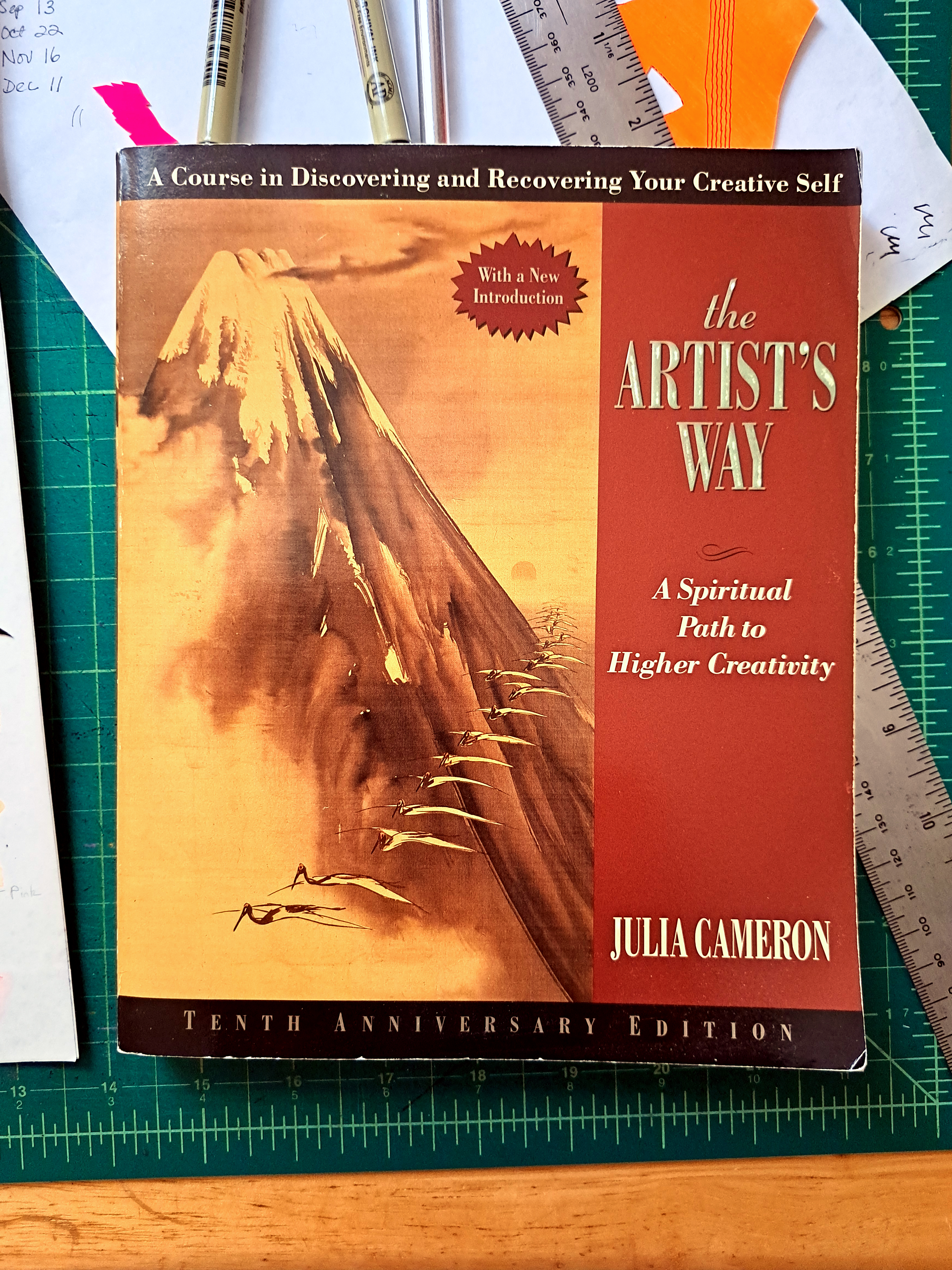
Lauren's copy of The Artist's Way
*How would you describe The Artist’s Way to someone who hasn’t heard of it?
L: A guidebook for cultivating and supporting creativity. Full of lots of practical guidance, tactics, questions, observations and rules! But it’s more than that. It’s a spiritual experience. I just noticed that Julia Cameron refers to it as a “sourcebook”! That works!
K: I would say that The Artist’s Way is a program that helps you discover, confront, and ultimately dispel whatever biases you have about yourself and your artwork. It’ll help you clear the air in your own head, so you can get down to the business of practicing your art.
N: The Artist’s Way is a book that contains exercises focused on creativity. It’s not just like ‘let’s make something’, though. It's more meta in the way it approaches creativity, because it asks you to consider certain attitudes that affect how you approach creativity and how you can remove roadblocks in order to freely create. It directs you to think about how you think about creativity.
*What did you like most about reading the book (and why)?
L: It pushed me out of my element! I liked this, but it wasn’t always comfortable!
Prior to starting the book, my studio practice already felt expansive. With The Artist’s Way as a guide, I opened up to other art-adjacent areas that I have been interested in but never really wholeheartedly pursued. For instance, writing about art. Not only did I not feel particularly confident about my writing, I felt that pursuing writing would be a distraction from my so-called “real” work in the studio. The Artist’s Way helped me to see that both are intertwined and do not have to be mutually exclusive. At the risk of sounding like a really slow learner, I finally realized that I do not need anyone’s permission to write about art, that I could write how I wanted, I could write about anything I wanted and I could be inconsistent, silly, weird, and so on.
Another important focus was the process of defining “success” for myself. Similar to my earlier thoughts on writing, I think my initial definition of “success” revolved around other artists, curators, critics, gallerists, etc. responses to my work. The book helped me to find the edges of my own, personal definition. Finishing the book actually felt like the beginning of the path–doing the book was kind of this odd, intermediary metamorphosis phase where lots of new ideas were just beginning to bubble to the surface. I am still working on a personal definition of success, but this process has been pretty profound and reinvigorating for my artistic practice and my outlook on life as a whole.
K: I was surprised to find that I loved writing the morning pages, and am still doing them (almost) daily! I’ve written more about my experience with morning pages here.
N: Each time I have read the book, Julia Cameron’s compassion towards creatives has stood out, and so has the way she encourages us to be kinder to ourselves. The first time I read it, I was struck by the section about the ‘Inner Critic’, and how (according to Cameron) this mean monster way of treating ourselves and our work didn’t have to be something we keep doing. The information is just as poignant now, as I still have to work on separating from my Inner Critic, and I probably always will.
Lauren's The Artist's Way and her Morning Pages journals
*What did you like least about reading the book (and why)?
L: One of the hardest parts for me were the affirmations. I didn’t feel like I got much out of them, but I think I may not be taking them seriously enough. I thought that writing every morning would be the hardest component, but I really got into the morning pages. In fact, I still write three pages every morning.
If I’m being honest, artist dates were also a major challenge for me. I love the idea of artist dates, but found them really hard to fit into my schedule between teaching, the studio, parenting and having a life. It was really challenging to give myself that time! I did do the artist dates every week, but they were pretty tame. If I did the book again, I would push the adventurousness of my artist dates.
K: I agree with Lauren - the affirmations were tough for me. I really tried hard, but they just felt silly, and like I was trying to affirm things that were ultimately out of my control. I quit doing them.
N: Morning Pages were/are a tough commitment for me, because I often feel impatient and like I am wasting time while writing them. The second time I tried to read/do the book, I quit because I didn’t want to do Morning Pages, and I didn’t feel right about reading the book without also doing the exercises. I’ve gotten around that this time by being more flexible with my expectations for the writing (instead of doing 3 pages, I do one, I usually don't write on weekends, I don’t always write in the morning, etc.). I know I’m not getting some of the intended value by not writing the full 3 pages, but I am still getting something important from them by developing a strong relationship with my inner voice.
Artist Dates are also tough, but for some reason I’m not as hard on myself about not getting those in each week as I am about the writing. Maybe because since they seem fun, I don’t feel guilty when I miss them. This definitely says something about internalized ideals and expectations around “work” versus “play”... something to think about.
*How did the book change the way you think about your work or yourself?
L: I think it changed the way I think about myself, more so than my work. That’s really what I needed, a way to feel more confident in myself even if I was not getting outside reinforcement. It helped me to develop a more nurturing inner voice, as well as develop more constructive relationships to success, work and time.
K: The book really changed the way I view my artistic practice in relation to other parts of my life. I have a lot of other responsibilities and interests, and I used to feel guilty about not spending enough time in the studio, especially whenever I was ‘indulging’ in something for fun, vs work or family obligations. Completing The Artist’s Way helped me find peace around all of this. Not only do I feel a lot less guilty about pursuing these other interests, but I’ve come to view my wide ranging skill set as something of a super power, and am now looking for ways of folding these skills and interests into my studio practice. The Artist’s Way helped me feel like a whole person, instead of feeling like my attention was constantly being pulled in different directions.
N: Detaching from my Inner Critic, was (and is) a really big deal for me.
Acknowledging the importance of play in the creative process via Artist Dates has also helped me follow different routes in the studio and take time to consider ideas that might otherwise have seemed like sidetracks.
The Artist’s Way was the first authoritative voice for me that said it was good to embrace the things you love and that bring pleasure and joy (in making your work), and that it’s okay to enjoy these things without having to rationalize and verbalize the meaning of it all.
Looking for synchronicities every week and every day has also become important thanks to The Artist’s Way. It feels like a different, more magical take on a gratitude practice.
Nikki's copy
*Who would you recommend this book to? What do they need to know before they start?
L: I’d recommend this book to art students, people who think that they’re not creative, all artists/creatives, even people that think they don’t need it. Maybe everyone needs this book?!
Follow the rules! Do the hard questions/tasks (I’m 100% talking to myself here, as I bent a lot of the rules and tried to avoid some questions and prompts that I didn’t want to answer).
K: Honestly, I think this book would be perfect for anyone with big goals, whether or not they’re art related. The book’s real power is helping the reader create structure and discipline that are tailored to their life, and therefore easier to maintain long-term, but it takes work. I would advise anyone considering this book to be sure to give it enough time - at least 30 minutes to an hour of writing each day (sometimes more), and several more hours each week for reading and Artist Dates. I was really grateful to have started it over Winter Break, so I could get used to the routine before my spring classes started.
N: I would recommend the book to any artist, and anyone who engages thoughtfully with the creative act. You will get out of it in direct proportion to the effort you put in. AND if you can go through it with a small group of creative people who are serious about it, and who will do the weekly check-ins, your experience will be enriched, because learning how The Artist’s Way is working for others will help you see better the ways it’s working for you too. It is great to do the book by yourself, it’s incredibly valuable either way, but if you can read and share about it with people you trust, the experience will be richer.
I am not being hyperbolic in saying the book has changed my life each of the times I have read it, and I am so grateful to Lauren and Katherine for being part of that this time around.
*Will you read/do The Artist’s Way again? Why/why not? If yes, when?
N: I will do The Artist’s Way again, but I don’t know when. I’ve (mostly- I took a break for 2 weeks) continued the practice of the Morning Pages since completing it this last time, but I allow myself to do a daily (on weekdays) abbreviated version (about a page) in order to keep it going. It’s been a useful practice to check in with myself and get grounded. Every time I’ve undertaken The Artist’s Way (except for the first time when I didn’t know what to expect), I’ve felt apprehension and dread about committing to the Morning Pages all over again, and I think I would still feel this way coming back to it for a fourth time. I don’t know why they feel like such a hurdle, BUT I also feel excited about when it will seem like the right time to do the book again.
L: I will definitely do it again. I’ve also continued to write morning pages and check-in weekly with Nikki and Katherine. I have also periodically looked back through the book, when I’ve felt like I needed a reminder.
I don’t know when, but I have a feeling that I will go through the entire book again, at some point!
K: The Artist’s Way still feels so present, it’s hard to imagine doing it again! But I could see myself doing it the next time I feel stuck. I’m currently working towards a show next year. It’ll be my biggest solo show so far(!!) and I definitely would not have landed without doing The Artist’s Way, and Nikki and Lauren’s support! The last time I completed a big project, I felt stuck and directionless for about a year. I would definitely consider doing The Artist’s Way if that happens again, but then again, the morning pages are helping to generate so many ideas that it may not happen this time. We’ll see!
Have you completed The Artist's Way? How was your experience? We would like to hear about it! Please share in the comments.




%20-%20Katherine%20Knight.jpg)


