Showing posts with label studio stuff. Show all posts

Wednesday, June 12, 2024

Reflecting on Rejection: Two Reasons We're Not Getting Into Juried Shows


When you submit work to a juried show and it gets declined, do you check out the show after it’s up (either online or in person)? Or is your attitude more along the lines of trying to forget about the rejection letter and moving on to other things?

For as long as I have been applying for shows, my feelings aligned with the latter, and I didn’t see much value in dwelling on what felt like missed opportunities. In the last couple of years, I’ve gotten curious about jurors’ and curators’ tastes and what work fits what they’re looking for, and why my work sometimes has not.


Assuming that we are meeting the basic entry requirements for a show (providing excellent images of strong work, fitting our statements into word count limits, etc.), there are two main reasons I’ve noticed for why my (and probably also your own) work hasn’t been included in juried shows. One of them may surprise you.


The least surprising reason for a rejection: the work doesn’t fit with the whole of the show. This can be a case of “the juror just didn’t like it,” but it can also be more subtle, relating to slight formal or conceptual mismatches. One of the first things I look for when I am trying to figure out why my work didn’t get into a show is the exhibition’s overall formal vibe; often, my colorful, graphic work presents a glaring contrast to a group of work that has softer edges or more muted colors. 


Conceptual mismatches can be harder to pinpoint, and if a juror provides a statement about their selections, this is helpful. I recently submitted work that was declined from a ‘nature’ themed show, and even after reading the juror’s statement and viewing the accepted work, I was struggling to determine why my work was not a fit. I was about to chalk it up to “they just didn’t like it,” (which may also have been the case) when I finally realized that all of the works in the show were speaking to broader topics relating to the natural world, like climate change, sustainability, etc., while my work instead presents a quirky microcosm that is more about a single moment in time. 


After I realized this, it seemed obvious, but it can be difficult to consider our work objectively. This kind of thinking is valuable, because considering why our work isn’t included in a show can point us towards contexts that will be a better fit.


A more surprising reason for our work’s rejection from a show: our work is already in the show. By this, I mean there is work included in the show that is visually very similar to ours. “Very” is subjective and sometimes hard to determine because we are able to attune to all the ways our work stands out that may not be as apparent to a juror, especially when they have just viewed 599 other applications. In this case, there may also be something else in the application packet that gives the selected work a leg up. For example, if CV’s are part of the application requirements, the selected artist’s CV may be more developed than our own.


This happened to me several years ago, when I noted in a group show I had been rejected from work that, like my own, was very colorful, with graphic edges and lots of patterns. However, I knew this artist’s name and was even familiar with curatorial projects they had developed. It was easy to see that while my work might have filled the same visual slot as this artist’s, their more prestigious CV could add value to the group exhibition in a way that mine could not.


It is always disappointing to get a rejection letter for an opportunity that we want, but if we take the time to consider the larger picture of where our work fits (or doesn’t) and why, we may* be able to pick better suited opportunities going forward. 


*To some degree, applying for things is always a roll of the dice. But we only have a chance at getting the things that we do apply for.


Thursday, February 29, 2024

How Do You Protect Works on Paper? An Informal Materials Test

 In December of 2022, I decided to run a test to determine a couple of things:

  1. How lightfast (resistant to fading or changing caused by light) are my most commonly used collage materials?

  2. How well-protected are these materials by my usual framing methods (UV resistant plexiglass)?

  3. Should I incorporate UV protective spray for additional protection? 


Works on paper can be delicate and susceptible to changes caused by light exposure. I also use a lot of fluorescent colors in my work, and even with protection, fluorescent pigments change over time. I had recently discovered Lascaux UV Protect spray, and I was excited that it could further preserve my work in addition to the UV resistant plexiglass I already include in my frames. 


Initially, I planned just to treat some scraps with the Lascaux spray and leave them in a bright window for a while, but after thinking more about it, I decided to run several tests:


  1. A full sun control collage- no UV resistant spray or plexi

  2. A fully protected collage- treated with both UV resistant spray and covered by UV resistant plexiglass

  3. Collage treated with UV resistant spray (no plexi)

  4. Collage covered by UV resistant plexi (no spray)

  5. No sun control collage- kept in a cigar box in a flat file drawer


I ran the exposure test from December of 2022 through December of 2023, with all collages placed in a window that received southeast sun exposure for at least 4 hours each day of an average Virginia year (usual amounts of sun/cloudiness).


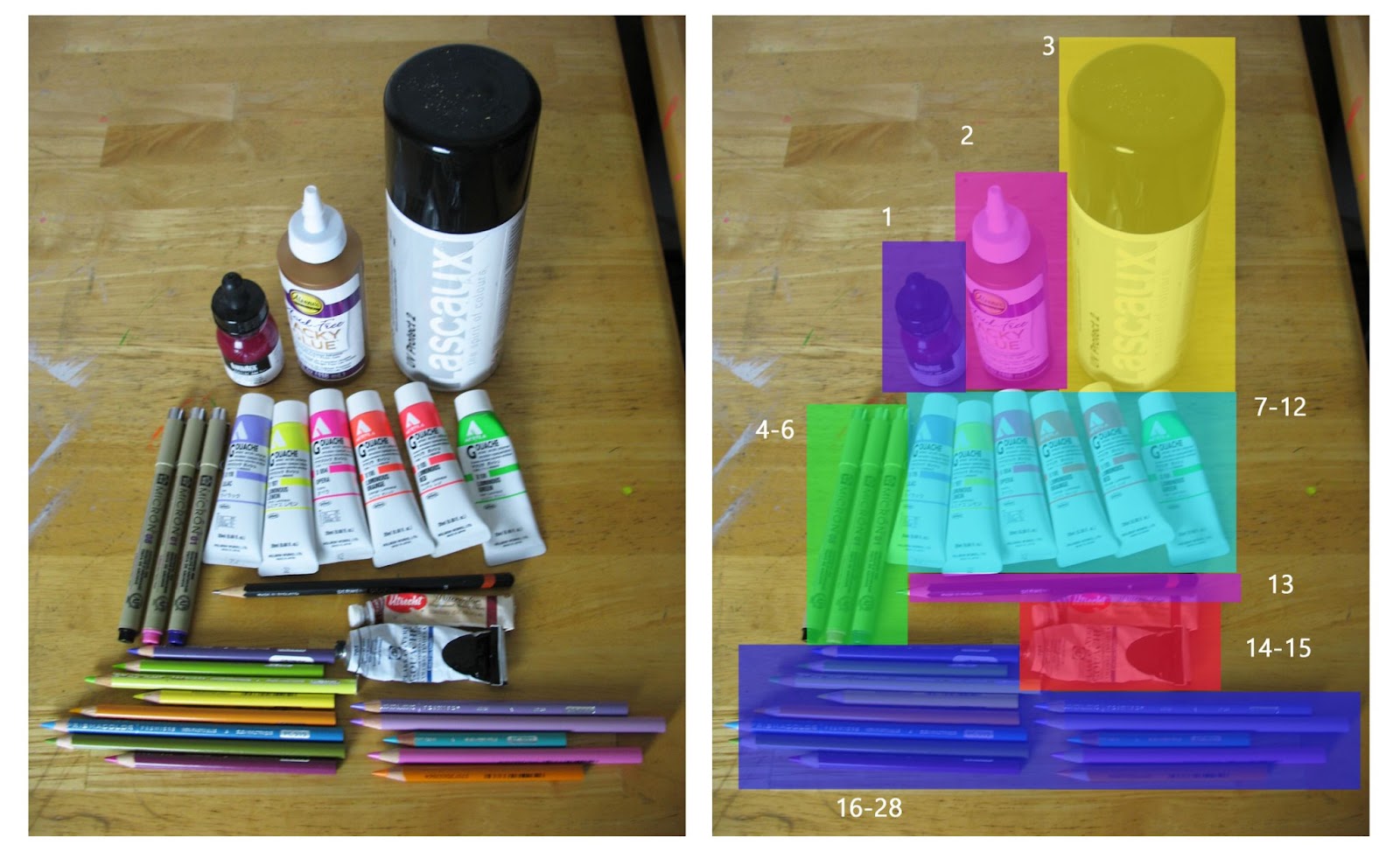
Here are the materials I used: 


  1. Liquitex Acrylic Ink (quinacridone magenta)

  2. Aleene’s Acid Free Tacky glue

  3. Lascaux UV Protect spray (matte)

  4. Micron Pigma Liner (black)

  5. Micron Pigma Liner (rose)

  6. Micron Pigma Liner (violet)

  7. Holbein Acryla Gouache paint (lilac)

  8. Holbein Acryla Gouache paint (luminous lemon)

  9. Holbein Acryla Gouache paint (opera)

  10. Holbein Acryla Gouache paint (luminous orange)

  11. Holbein Acryla Gouache paint (luminous red)

  12. Holbein Acryla Gouache paint (luminous green)

  13. Derwent graphite pencil

  14. Utrecht Watercolor (alizarin crimson)

  15. Talons Gouache (intense black)

16-28. Prismacolor colored pencils (left column, top to bottom) parma violet, chartreuse, yellow
            chartreuse, lemon yellow, spanish orange, non-photo blue, limepeel, process red

            (right column, top to bottom) lilac, lavender, light aqua, hot pink, yellow orange

***Paper used for all tests is Canson XL Bristol paper.*** 


Here are the test collages after their year of exposure:


No sun exposure (left) vs. Full sun exposure (right)


UV resistant plexi (left) vs. UV resistant spray (right)


No sun exposure (left) vs. UV resistant plexi with UV resistant spray (right)


Predictions:


  • Micron pen areas will come out the best (least fading). Prismacolor pencil swatches will be second best. Regular graphite will also do well.

  • Best result will be the collage protected by UV spray and UV resistant plexiglass, right?


Observations:


  • I was surprised by the amount of fading in the bottom row of colored pencil swatches, especially in the lilac and lavender colors. 

  • Gouache and watercolor that were applied opaquely did well. Pigments applied as a wash faded A LOT, regardless of their level of UV protection (best shown by the red rectangle placed in the bottom left corner of all of the collages).

  • The Lascaux spray didn’t seem to provide any extra protection (when compared head to head vs. the UV resistant plexi), AND it created a hazy cast on the black Micron areas of collages (you can see this in the black and white striped pieces near the middle of each collage) and also on the bottom right burgundy rectangles (mixture of watercolor and black gouache). Could this be the result of the matte finish? There are also semi-matte and gloss versions available. Is the one I got just funky? Based on this experience, I would not recommend it, but online reviews seem positive.

  • BEST outcome (besides no sun exposure): collage protected by UV resistant plexiglass, for the win! It had some fading, but not fading along with hazy areas caused by the Lascaux spray. 


It is good to see real proof that UV resistant plexi is protective of the types of materials I usually use. Going forward, I will continue to include it in frames, and I will also try to avoid washy/thin areas of pigment.


Of course, the best protection for works on paper is always to keep them away from sunlight and fluorescent lighting.


Do you have any best practices for protecting works on paper? Have you had a better experience with UV protective spray? Please feel free to share in the comments.


Monday, January 29, 2024

2023 Reflections (Nikki)

Studio sun

2023 was very much a back to basics year for me, as I experienced health issues that had me researching how to get back to a better (physical/mental) baseline. Because of this, the year's overall theme was maintaining new routines. These are lessons I learn and relearn: celebrate small wins, and small steps add up. I feel hopeful that 2024 will be a great year due to changes I made in 2023.

In no particular order, five things that sustained me in the past year:


*Health changes- getting sunlight first thing in the morning, eating more, eating regularly, eating less processed food, eating more protein, going to bed earlier, strength training, getting outside more


*Reading before bed- I look forward to this so much, as it’s become part of my routine and helps me wind down. Favorite books of the year: Tomorrow and Tomorrow and Tomorrow by Gabrielle Zevin, the My Brilliant Friend trilogy by Elena Ferrante, and for art/creativity-related books: The Creative Act by Rick Rubin


*Working consistently in the studio- not a change, just something that continues to be a mainstay for many reasons


*Looking for free opportunities- paying to apply for opportunities has always been something I accepted as part of getting my work in front of new eyes, but I decided to take a break from it for most of 2023. Fortunately, I was asked to participate in shows by friends and past connections, in addition to finding free opportunities. As a professional experiment, this reminded me that I can be selective about opportunities, without feeling nervous about gaps on my CV. I’d like to continue this through 2024, but we’ll see how it goes


*Less time on social media


*And a bonus thing- easy gluten-free pumpkin muffins:


Box of King Arthur’s gluten free muffin mix- follow the directions on the box, but skip the milk and add: 15 oz. can pumpkin, 3 tsp pumpkin pie spice. Use an electric mixer or electric hand mixer to make sure ingredients are thoroughly combined


I have been making these since October and love them for all year round.


Cheers to the new year!


Tuesday, October 31, 2023

Beating a Block


I recently had conversations with some artist friends about how we defeat that dreaded state artists (and creatives) feel at least once in their lives. We were discussing how to get out of a block.


Being “blocked” is interesting in that it’s something only you can determine applies to you. I might think of someone that hasn’t made work in years as being blocked, but they might describe themselves as simply taking a break. You know it if you’re in it, that strange frozen feeling that happens when you just can’t make work. 


Of course, you CAN do it. A block doesn’t refer to the physical inability to make things; instead, it refers to a mental block or a mindset that results in not taking action. Being blocked is being stuck, and ending a block requires the decision followed by the actions taken towards making. It sounds simple, but somehow, it's not.


Our conversations defined some must-haves for beating a block:


Material concerns- These run the gamut from having things necessary to make your work, to having a space that fosters your practice. I’ve tricked myself out of blocks a few times by purchasing new materials (the feeling that I’ve spent money, so now I can’t “waste” it by not working has spurred me to action). 


At other times, I’ve exited a block by cleaning up my workspace. Knowing that my space is tidy and ready to get filled up with new work is motivating.


Work redefined- When we experience a block, it is helpful to rethink our definition of “work.” 


Once, after I hadn’t been in the studio for what felt like eons (it might have actually been two weeks), I convinced myself to get back in there by saying “You don’t even have to work, just spend 10 minutes getting ready to work,” and then I did tasks like reorganizing paper and pens, printing out calendars for the months ahead, and so on. Tasks we don’t think of as the actual work (other examples: cutting down paper, cleaning out a sink, researching opportunities, etc.), ARE in fact work, and some part of our brain recognizes this. We can use these small steps to shift a blocked mind closer to one that is ready for flow and ready for creating.


Time- Small time periods are important. When I’ve been away from working, getting back to it has felt like coming back to a sport: I remember how to do it, but I don’t have the same endurance level. I need to condition myself with smaller time periods of work to get back to the place where I can focus and work for hours on end. Usually it comes back quickly. Even though I tell myself I only need to do tasks (or work) for 10 minutes, 10 minutes easily stretches to half an hour, which soon becomes an hour, and so on. 


I have also gone through periods where I felt that, “Oh, I can’t do ANYTHING unless I have at least an hour!” But if you’ve been blocked for a while, 10 minutes a day for 2 weeks adds up to much more than 0 minutes a day for two weeks. You can do a lot with 10 minutes. 


Picking up the threads- Possibly the most complex piece of beating a block, because it’s so specific to the path you have been on in your work, “picking up the threads” refers to how you decide what you’re going to make. The ‘threads’ of what you make next will have some relationship to the work you’ve already made- whether you want to continue with familiar ideas and materials, or whether you want to diverge from what you’ve been doing.


In 2019, I needed to focus the work I was making. I was dealing with what felt like a very heavy block because I felt overwhelmed by the various paths my work had taken (I was working on at least 5 different bodies of work). Someone else might experience a block because they need to expand their practice and try something new. Ultimately, you are the only one who can pick up the thread of what needs to happen next in your practice.


Picking up the threads is so important, because once you’ve chosen what you are going to make, your excitement and desire to see your new work realized and out in the world may be all it takes to beat your block. 


But what if it’s not?


Being blocked can be the result of issues beyond not knowing what to make: depression or other mental health challenges, grieving, illness, life changes, and so on. In the case where you have all of the pieces in place: the materials, the time, the ideas for new work, but you still feel unable to take the step to make work, it’s okay to go easy on yourself and accept that your blocked state may actually be a signal from your unconscious that you need to take a break. 


This was also true of me in 2019. I had been working so hard the previous couple of years towards what (for me) was a massive show, and instead of taking time to rest and celebrate the work I had done, I immediately jumped to worrying about what I would make next and whether it would align with some imagined, collective expectations of me. I wish I had spent less time worrying and thinking about the future and more time being present, feeling proud of the work I had just accomplished. 


We think of being blocked as a problem to solve as soon as possible. In cases when this is true (hello, deadlines), hopefully the above thoughts can help you get back to work.


And if you have the opportunity, examine whether your block is a signal from your subconscious that you need something different, like more time to rest, or to follow a new direction with your work.


Blocks happen. Creativity and productivity are not meant to be sustained all hours of every day, 365 days of every year.


Sometimes a block is a block, and sometimes it is a sign that it’s time for a change. 


How have you beat a creative block? Please share in the comments!


Saturday, May 13, 2023

Thoughts About Success


I recently read a review of a group exhibition, and the critic mentioned that in the time since making the work included in the show, some of the artists had “failed.” 


I had ideas about what the critic meant by that statement, but then I wondered what it meant to me. How does an artist fail? The main thing I could come up with was that to have failed, they would have given up on making work.* 


Around the same time I was also thinking about how we (artists) define success for ourselves.


We all have ideas about what it looks like. We see examples of success all the time, because it’s the main part of the job that’s public: the exhibitions, the awards, the publications…the lines on people’s CV’s. And there is social media, where we spotlight our success.

We know what success looks like for everyone else, but the most important thing we can do for ourselves is determining what success looks like for us. And we need to practice feeling successful in the present moment. 


 *This is not the same as taking a break from making work. Taking a break is not failure. But does the decision to give up discount all of the work an artist made prior to that decision? That doesn’t seem right.


A personal definition of success: considerations and goals


Possible considerations for defining what success looks like for us:


*Our work- does it excite us, does it challenge us, are we working to improve it, does it express our values?


*Our community- how are we showing up for others and providing opportunities or resources? Do we give more than we take?


*Our resources- what do we have space, finances, and mental/physical/emotional energy to realistically accomplish at this time?


When we consider these career components (or others), do we give ourselves related goals based on things we can control? If not, our goals for achieving success are based on external sources of validation (like shows, prizes, or anything where we have to be ‘picked’ by someone else), not solely on the work we are putting in.


As an example, a few years ago, I started the new year with several career goals. One was to apply for 3 opportunities per month. Another was to add 3 group shows to my CV for the year. The first of these goals I had infinitely more control over than the second, because having work included in shows relies on others’ curatorial decisions, but my submitting applications was a goal based on my own efforts. Some goals for achieving success are more valuable, because they acknowledge the amount of work we have done, not the way external sources perceive that work. 


When we recognize our own success based on the work we have put in, we are also practicing our ability to feel successful in the present moment.


Success in the present moment


If we want to pursue our career by seeking out external validation, we can absolutely do that. But what if the work we care most about making is never “in” during our lifetime? Or what if we never make the right connections to show in the right spaces? Do we choose to see ourselves as failures because external factors don’t work out in our favor?


During the last few years, growing awareness of ‘hustle culture’ has helped many of us consider how we treat ourselves around our perceived success (or lack thereof). We still have a long way to go.


One of the greatest successes we can have is an attitude of kindness towards ourselves. We can care about our goals and work at our highest level, while realizing that many things are out of our control. We can celebrate ourselves when we win and alternately, we can be satisfied in knowing that we did our best and will try again when our work is not chosen. We can choose our own version of success instead of waiting for The Art World to anoint us. 


My ideas about success have changed a lot over the last few years. When I think about something I want to achieve, I consider whether it really matters to me (and why), or whether it’s something I feel like I should do (in the best of scenarios, these overlap). For me, right now, success means I am treating myself with compassion and I am making work that I feel excited about. 


It’s been said that the only person we need to impress is ourselves at 17 and ourselves at 70. I agree with this, partly. Instead, I’d say that the only person I need to impress is me, right now. 17-year-old me had no idea what today-me would be dealing with, and I believe that 70-year-old me will feel proud knowing that today-me did the best that I could, even if I don’t achieve things the rest of the world considers big or important. 


Regardless, I, right now, am the only version of me that will ever exist, and in order for 70-year- old me to feel a sense of pride and achievement, I need to start practicing that for myself now.


Success, or feeling successful, is a practice, but not in the way we think. It is a feeling we must cultivate in the present moment, not one we should strive to have in the future.


Related quotes:


“You have the right to work, but for the work's sake only. You have no right to the fruits of work. Desire for the fruits of work must never be your motive in working. 

… Work done with anxiety about results is far inferior to work done without such anxiety, in the calm of self-surrender. .... They who work selfishly for results are miserable.”

-paraphrased from the Bhagavad Gita


“Success is not a goal, it’s a byproduct.”

                -Coach Taylor, Friday Night Lights


“Whether you succeed or not is irrelevant- there is no such thing. Making your unknown known is the important thing- and keeping the unknown always beyond you…”

-Georgia O’Keeffe

Tuesday, March 21, 2023

Recent Studio Listens


What do you listen to while you work?

I go through phases when I listen to TV shows, audiobooks, or music. Right now I'm mainly listening to podcasts.

In no particular order, here are some of the podcast episodes I’ve enjoyed recently:


*Pep Talks for Artists, Episode 41: Artist Pet Peeves -This was really funny to me, and I can’t resist a non-toxic rant- actually I didn't know they were a thing until listening to this episode. Truly an art form in and of itself.


*The Art Career, Season 2, Episode 1: Mickalene Thomas: To Be an Artist is a Radical Act- Thomas’s comments on the gallery system are something I wish more people were talking about.


*Pep Talks for Artists, Episode 25: How to Work an Opening- So useful and practical. Feeling like I’ve lost any semblance of social non-awkwardness over the past several years, I will definitely remember these points next time I attend an opening.


*Lessons From a Quitter, Episode 241: Self-Love- I discovered Goli Kalkhoran on social media, and her simple tips for mindset work always make me feel hopeful. 


*About Art with Heidi Zuckerman, Episode 64: Beth Pickens- I love listening to Beth Pickens. I search for new podcast interviews with her every so often, and I recently discovered this one from 2021. In it, she talks about her favorite things: artists, advice, jobs, money, death, and more. Beth is a career therapist/coach for artists, and author of Your Art Will Save Your Life, and Make Your Art No Matter What.


*Klein Artist Works: Camille Seaman- Not a podcast, but so great, and so inspiring. Klein Artist Works was recommended by Virginia Broersma/The Artist’s Office.


*I Like Your Work- Chie Fueki- Chie Fueki has been a favorite artist of mine for a long time. This is the first time I’ve heard her talk about her work, and I loved it.


And a bonus: Sunlight Podcast. A podcast about taxes (specifically catering to artists and other creatives) might seem unusual, but if you care about your money, it's an excellent source of information.


What have you been listening to lately? Feel free to leave your own podcast, TV, audio book, etc. recommendations in the comments!


Short Answer Sunday: Katherine Knight

Welcome to Short Answer Sunday , an interview series where I ask artists, art adjacent individuals, and other interesting, creative people t...