Wednesday, October 11, 2023

6 + 1 Questions with Shaina Kasztelan

I am delighted to have another 6 + 1 interview to share. I am equally delighted that the interview is with Detroit-based artist Shaina Kasztelan.  I've been a fan of Shaina's work for a long time, since her years as an undergraduate art student at The College for Creative Studies. If you are even a little familiar with my own work, you are probably not surprised by the attraction—I’m drawn to painters that have an element of subversion in their work, whose use of materials expands the possibility of what can be included in a painting. Even classifying Shaina’s work only as painting feels narrow; the work is more contraption than window.

Contextually, looking at Shaina’s work through the lens of Halloween is rewarding. The paintings exude an undeniable October glammy kitsch: imagery of webs and wigs, bats and hats collide with faux leather and crushed velvet. Spandex stretches across plush surfaces. Painted marks comingle with swirls of synthetic hair, beads and textiles.

There’s more here, too, many layers to peel back and look beneath. Detroit, music, the 90’s, the history of abstraction and feminism all inform the work for me. I could go on and on…but I won’t. Let’s get to the good stuff: the interview. And Shaina’s gorgeous work.

Thank you, Shaina, for the generosity of your time and your willingness to share insight into your work and practice!

Shaina Kasztelan is currently completing her final year as an MFA candidate at Cranbrook Academy of Art in Bloomfield Hills, MI. Look for her work in the Cranbrook Graduate Degree show in Spring 2024.

❤❤❤


Shaina Kasztelan

Beyond the Black Rainbow


48” x 29” x 6”


Faux fur, upholstery fabric, fleece fabric, glitter, sequins, textile trim, acrylic paint, faux leather, rhinestones, synthetic hair, spandex, beads, plastic needlepoint mesh, yarn, polyester stuffing, crushed velvet, embroidery thread, puffy paint, sand


2023

LR: What’s your sign? If you are astrologically inclined, feel free to give your Sun/Moon/Rising. Do you identify with the characteristics of your sign(s)?

SK: I am a Gemini (May 25). I’m not astrologically inclined whatsoever but I do think horoscopes are fun to read and fantasize about! Looking up the characteristics of a Gemini online, I definitely identify with the majority of the various traits: 

-I’m naturally curious
-I love to learn
-I can be impulsive
-I love to have fun and I’m adventurous
-I’m adaptable
-I’m indecisive
-I have a variety of hobbies
-I’m quick-witted

The only one that I don’t completely identify with is being a social butterfly. I love hanging out with my friends and don’t really have trouble talking to strangers but my social battery gets drained very quickly. I love spending personal time alone and prefer smaller, more intimate interactions with others. Big groups can be fun but it’s very over stimulating so I end up spending more time observing (or nervously overcompensating by talking too much haha). 


Shaina Kasztelan

2c-B(irthday Cake) 


34” x 24” x 6”


Spandex, satin fabric, sequins, cotton fabric, textile trim, beads, lace, plastic chains, hot glue, latex paint, puffy stickers, balloons, resin, glitter, acrylic paint, polyester stuffing, faux leather, sand, faux fur, white opaque flakes, styrofoam 


2023


LR: What is your morning routine?

SK: I desperately want to be the type of person who has an active morning routine but to be honest, ever since 2020 it’s been very hard for me to form and stick with healthy habits. COVID lockdowns, leaving my dream job because of OSHA concerns, and the death of one of my best friends and also my father all within a short window of time really did a number on me. I still feel a huge void inside of me so it’s been a challenging transition but I'm trying to focus on being present with myself and not dwelling too much on the past or anxiously anticipating the future. There is a part of me that is really appreciative of the whole situation though because it forced me to confront bad habits and reevaluate what was important to me.

Something that has helped shift that perspective in the last year has been undergoing ketamine treatments at Michigan Progressive Health. They’ve really made me more emotionally aware, feel more connected to myself & the world around me, and recognize that life isn’t strictly based on extremes of always/never or good/evil; there is so much more nuance to consider and both can be true at the same time. It’s also helped override this “default mode” in my brain that keeps me feeling stuck in mechanical thoughts and behaviors and instead encourages me to embrace absurdity and the unknown.

Because of this shift, the only semblance of a routine I have right now is a mindfulness practice that encourages me to be present in the moment. I try to do it daily but I’m not perfect. It’s something that seems like it should be so simple but it can be difficult to make time for. Inspired by the Situationist International’s practice of dérive, it’s basically just walking an unplanned route, reflecting on different sensations I’m feeling, and spontaneously allowing myself to be drawn to different areas that capture my attention without overthinking it. I’ve stumbled upon so many beautiful sightings because of this which feels pretty serendipitous at times. The other day I walked up on a huge group of deer sleeping in the forest, all of them surrounding a stump covered in bright yellow mushrooms! I usually put on headphones and listen to something ambient like Pauline Anna Strom or Boards of Canada; music makes everything seem more grand and emotionally compelling, even if it’s just watching how the light shines through the leaves in the trees or feeling the temperature change on my skin when moving from an open field to a densely wooded area. Afterward, I like to journal about my experience to really reflect on my gratitude.

Overall, this practice of grounding is about celebrating fleeting moments that I might overlook when I’m rushed or burnt out, even if it’s something small and seemingly insignificant. It’s welcoming the unexpected, letting it capture my full attention, reveling in the fact that I was in the right place at the right time to witness it happening, and recognizing that there is value in slowing down and connecting with the world around us.


Shaina Kasztelan

Mystic Picnic


36” x 18.5” x 8.5”


Fake grass, wicker basket, acrylic paint, spray paint, rhinestones, plastic beads, plastic toys, dentures, sequins, embroidery thread, faux fur, Joann Fabrics printed cotton fabric, textile trim, wooden wagon wheel bracket, wooden toilet paper holder  


2022

LR: Have you ever cried in front of an artwork? If so, what was it?

SK: I’ve never cried in front of a static, singular artwork like in a gallery or museum setting (I did feel pretty emotional in the Thierry Mugler exhibition at the Brooklyn Museum this spring though; he is a queer icon and an amazing designer and with all of the drag queen “satanic panic” type culture war stuff going on, I felt some type of way) but I did tear up while watching a live performance of "Our Domestic Resurrection Circus" from the Bread and Puppet theater troupe this past fall. I had just found out about them a year prior while I was briefly involved in the MFA program for Set Design at Wayne State University but they’ve been around since the 1960’s, so I was really excited to hear that they would be coming to Hamtramck to perform at the Detroit Puppet Company. Their performances have always been political in nature, very anti-war & anti-capitalist, and they utilize large handmade paper mache puppets that are made collaboratively on a farm in Vermont. They also run a printing press and sell prints at the end of their performances. One of my favorite prints was their Cheap Art Manifesto.

It reads:  

“People have been thinking too long that art is a privilege of the museums & the rich. Art is not business! It does not belong to banks & fancy investors. Art is food. You can’t eat it but it feeds you. Art has to be cheap & available to everybody. It needs to be everywhere because it is the inside of the world. Art soothes pain! Art wakes up sleepers! Art fights against war and stupidity! Art sings Hallelujah! Art is for kitchens! Art is like good bread! Art is like green trees! Art is like white clouds in blue sky! Art is cheap! Hurrah”

What moved me the most about this performance was the community atmosphere. Weeks prior, they put out a call inviting locals to participate in the show. The day of, I arrived at the Detroit Puppet Company’s outdoor space with my best friend (& frequent creative collaborator) Heidi Barlow, my brother Jacob, and my sister-in-law Qingzhuo. The performance was free to attend and the area was full of families, couples, friends, neighbors, children, curious passersby, etc all packed together laying on blankets or sitting in lawn chairs across the grass facing this hand-painted old school bus. When 7pm hit a huge group of like 20 or so people came running out from behind the bus all dressed in white, carrying flags, bouncing around the perimeter of the stage, laughing and cheering as they circled each other. The energy was electric- I immediately started smiling so big and tearing up because it just hit me on such an emotional level being surrounded by all this collective joy. After an isolating pandemic, grieving the deaths of some really important people in my life, and just feeling pretty depressed about the future, this experience breathed new life into me. I highly recommend attending one of their shows if they ever come to a town near you. They are currently on tour this fall so keep an eye on their website! https://breadandpuppet.org/tour-schedule 


Shaina Kasztelan

Somewhere Over the Rainbow is a Double Rainbow


52” x 36” x 6”


Joann Fabrics printed cotton fabric, spandex, quilted fabric, acrylic paint, fleece fabric, faux fur, rhinestones, metal clasps, sand, beads, embroidery thread, textile trim, metal frames, found objects, polyester stuffing 


2023

LR:.What are you reading now? (You can also include what you’ve read lately, as well as what you are listening to, watching, etc.)

SK: I’ve been obsessively downloading tons of PDF’s from JSTOR while I have access to it via Cranbrook, so I have a seemingly never ending amount of content to browse for the next few years. Like my Gemini nature suggests- I’m on a quest for knowledge. There are many different subjects that I’m interested in researching and alluding to in my artwork: consumerism, psychedelic experiences, escapism, the act of play, the American suburbs, glitches, subcultures, American visual culture, Dada, Surrealism, sci-fi & horror movies, cartoons, internet culture, kitsch, queer camp, psychology, theater, nostalgia, the environment, etc. I also have like 100+ tabs open on my computer and phone of various articles, websites, PDFs, whatever. I’m slowly trying to organize my huge archive of research but there’s so much stuff it’s going to take a really long time.

Over the summer, I read (or am still in the process of reading):

Glitch Feminism by Legacy Russell
In Defense of the Poor Image by Hito Steyerl
Stolen Focus: Why You Can’t Pay Attention and How to Think Deeply Again by Johann Hari
Dopamine Nation by Anna Lembke
The City Authentic by David A. Banks

Things I’ve been (re)watching and (re)listening to lately:

-Brad Troemel’s Patreon video essays
-Beyond The Black Rainbow by Panos Cosmatos
-The Holy Mountain by Alejandro Jodorowsky
-Wonder Showzen
-Comedy Bang Bang podcast
-A lot of newer jazz, like Portico Quartet and Yussef Dayes
-My Life with the Thrill Kill Kult’s Confessions of a Knife album
-New Aphex Twin stuff. He’s a huge influence. His live set at the Warehouse Project in Manchester from 2019 is so amazing. I really like to bop around to that in the studio while I’m working.


LR: Tell us four truths about yourself and one lie (in any order, just don’t give away the lie!):

SK:

a. I have four cats.
b. I’ve known my fiance since we were teenagers.
c. I’ve done some of my own piercings/tattoos.
d. I am an only child.
e. I’ve only ever lived in Michigan.


Shaina Kasztelan

Would You Like to Have a Happy Heart?


62” x 33” x 18”


Fleece fabric, Joann Fabrics printed cotton fabric, plastic toys, colored pencils w/erasers, resin, glitter, textile trim, plastic pills, beads, acrylic paint, sequin witch hat, dowel rod, decorative metal hooks, studded belt, plastic toilet paper rack, synthetic hair


2022

LR: Wild card! Can you share a bit about how play and experimentation relate to your artistic practice? How does failure play a role in your work?

SK: Play and experimentation are absolutely crucial to my work- they are the main drivers behind my entire practice. Having a day job in production over the past few years, everything I built had to be meticulously planned or constructed based on someone else’s blueprints with no room for my own personal touch. I had to perfectly follow my boss’s instructions and work as quickly and efficiently as possible which meant a lot of pre-planning and sticking to a strict schedule. It definitely exacerbated my perfectionism! In my own studio, I try to let that all go and allow myself much more freedom.

I really enjoy working intuitively and being spontaneous. I can just sort of turn off my logical brain and make intuitive connections in the moment based on responding to color, shapes, material, etc. I use a lot of found objects and found images in my work so I’ll start by going through bins full of junk that I have on my shelves or on my computer and pairing things together. Maybe there is a toy that fits perfectly into the curvature of another random object or maybe there is an object that is referenced in a found image that I’ll print off and incorporate. From there it’s kind of just moving things around, breaking them apart, manipulating them, and putting them back together in different ways until something feels right.

I try not to overthink it; if I plan too much or if the work translates too literally on a conceptual level then I get bored of a piece really easily. I am much more interested in work that surprises and challenges me. I want to sit with a piece and question what I’m even looking at and how did I get there.

Failure has taught me a lot in the studio. It took me a while to appreciate it, but now I welcome and oftentimes seek out those experiences. I have worked in a lot of different creative industries and have a huge skill set but I don’t have all the answers, so when something fails it teaches me a lot about what went right, what went wrong, and how I can change the results next time. Sometimes it’s something important like a matter of structural integrity which helps me become a better builder on future projects. Sometimes it’s just an unexpected material reaction which can be really weird and exciting. I’ve stumbled across a lot of great textures by accident because I mixed the wrong things together or added too much of something. It has never ended up in catastrophe, but when things have failed it’s opened up a whole new world of possibilities I would have otherwise never experienced.

Failure is inevitable; I don’t want to gloss over the messy parts of life and hide it under the rug. It feels more honest and human allowing scars to show rather than creating the illusion of a smooth, impervious shield. People who expect anything to be perfect in life are just going to end up very disappointed. I think reframing our experiences of failure as an educational guide rather than a moral judgment of character is a healthier outlook for all aspects of our lives.

LR:  What other artist(s) would you like to see answer these questions?

SK: My Cranbrook studiomates Sara Nickelson and Olivia Guterson! And BFF Heidi Barlow!


Shaina Kasztelan is a multidisciplinary artist based in Detroit, Michigan. Her artwork takes on many forms including painting, sculpture, and installation. She received her BFA from the College for Creative Studies in Detroit and is currently pursuing her MFA at Cranbrook Academy of Art in Bloomfield Hills, MI with a concentration in painting. Her work has been exhibited in various institutions including the Detroit Institute of Arts, Detroit Artist Market, and the Museum of Contemporary Art Detroit. Painting murals has transported her work internationally from the NXNE Music Festival in Toronto, Canada to the CIMU Mural Festival in Mexico City, Mexico. In addition to creating work in her studio, Kasztelan has assisted many artists throughout her career. Most notably, she has worked in collaboration with a group of painters executing the mural work of Gabe Gault in Toledo, Ohio, which is currently the largest mural in the United States. As a production assistant, she has collaborated with a creative team building parade floats for America's Thanksgiving Day Parade in Detroit as well as theater sets for Wayne State University's Hilberry Theatre. 

Find her work at: http://www.shainakasztelan.com/ or @clowntearz on Instagram

💖

All images courtesy of the artist.

Thursday, August 31, 2023

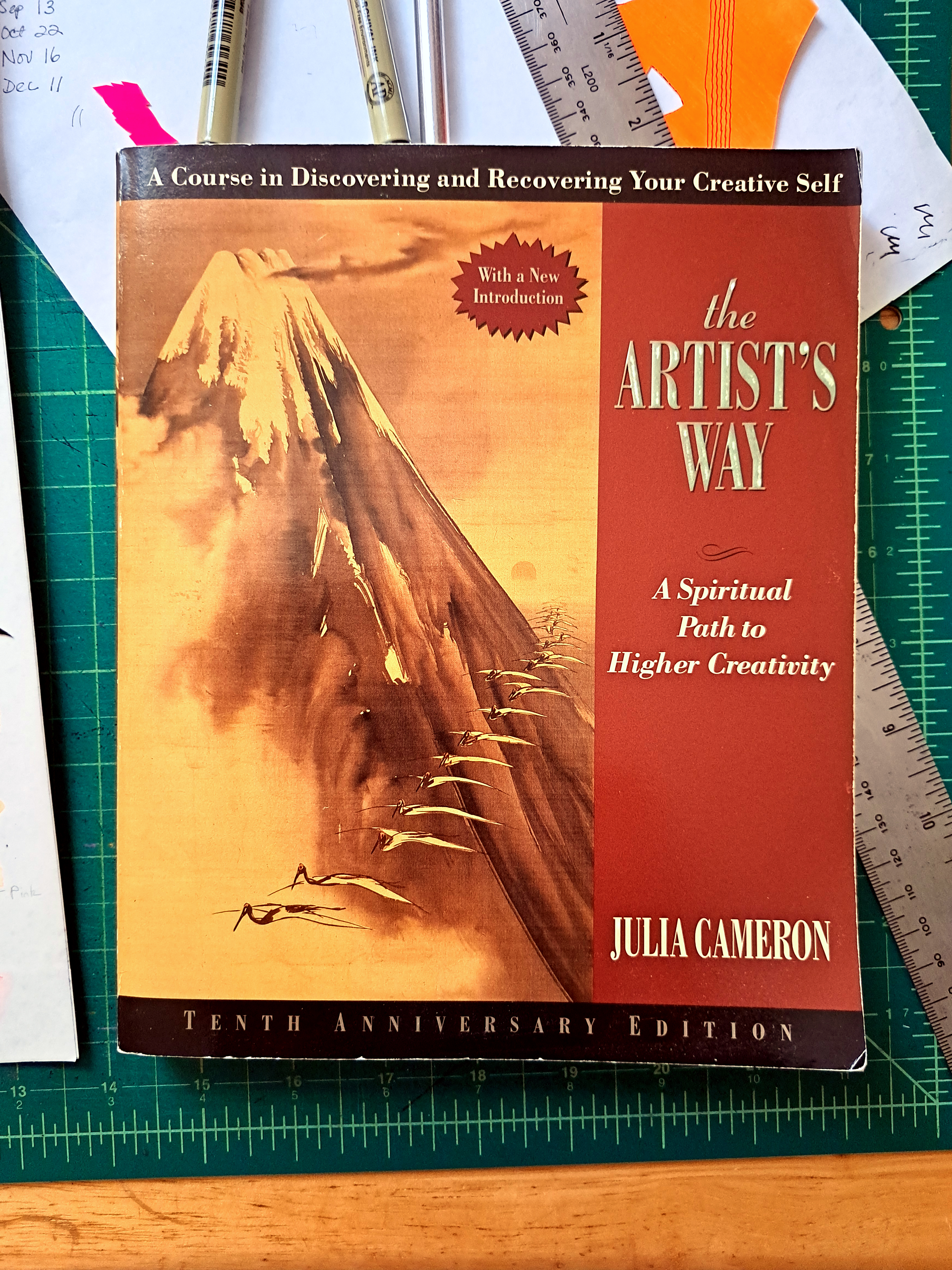
The Artist's Way: A Group Book Review


Katherine's copy of The Artist's Way by Julia Cameron with her journals full of Morning Pages

*How did we decide to do The Artist’s Way as a group?

Lauren: My memory is that I may have brought it up during one of our meetings. I noticed several groups of artists on Instagram working through the book together during the early Covid era in 2020-2021. I had also read about it in Carol Bove’s essay The Four-Hour Art Week: Read Carol Bove’s Self Help Guide for Artists from Akademie X. If Carol Bove was into it, how bad could it be? I may be wrong, but I think we started discussing it before Brian and I moved into our new house. Nikki you mentioned you had done it in the past. I think it took us a while to start, because we were in the new house when we began (November 2021?). We were all a little reluctant, I think.


Katherine: Yes - I agree with Lauren! I remember someone bringing it up in one of our monthly Zoom’s. I can’t remember if it was Nikki or Lauren, but I know that I was the only one who had never heard of it before.


Nikki: This is how I remember it too, and I think I was slightly pro- reading it, because I had also recently noticed some people posting about it on Instagram. But I also felt reluctant because I wasn’t sure I was ready to tackle Morning Pages again. But I thought it would be fun to read it with Lauren and Katherine! 


*What were your expectations or hopes going into reading the book?


N: I had read the book before, and actually felt like it led to my decision to quit a public school teaching job and apply to grad school… In some ways it feels like I owe my whole career to The Artist’s Way, so I definitely felt like big things could happen from re-reading it. I was also apprehensive, because I had tried to re-read it a second time previously and just couldn’t deal with the Morning Pages, so I felt worried I might have to (or might want to) tap out at some point.


L: I have no idea what I was expecting! I had the impression that I didn’t need the book, that it was all about being blocked as an artist. As an artist who rarely has been blocked, I doubted that it would be helpful at all. I did think that it might be helpful to share with students in the future, so I initially conceived of it as a teaching tool.


K: Lauren’s recollection about us being reluctant to start the book is spot-on. I had MANY reservations about this endeavor - it just felt like such a huge undertaking. I’m not a morning person, and I’d sworn off journaling in my early 20’s after realizing that I was just wallowing in my misery, and it made my life worse, not better. BUT - I trust Nikki and Lauren, and in the 2020 mindset I was really looking forward to doing something together as a group. My only hope was to just get through the book. I secretly gave myself permission to quit the morning journaling if it started bumming me out (sorry guys!). Spoiler alert: I’m SO GLAD I did it. The experience was every bit as transformative as everyone says it is, and I was definitely a skeptical/tough customer.


  Lauren's copy of The Artist's Way


*How would you describe The Artist’s Way to someone who hasn’t heard of it?


L: A guidebook for cultivating and supporting creativity. Full of lots of practical guidance, tactics, questions, observations and rules! But it’s more than that. It’s a spiritual experience. I just noticed that Julia Cameron refers to it as a “sourcebook”! That works!


K: I would say that The Artist’s Way is a program that helps you discover, confront, and ultimately dispel whatever biases you have about yourself and your artwork. It’ll help you clear the air in your own head, so you can get down to the business of practicing your art.


N: The Artist’s Way is a book that contains exercises focused on creativity. It’s not just like ‘let’s make something’, though. It's more meta in the way it approaches creativity, because it asks you to consider certain attitudes that affect how you approach creativity and how you can remove roadblocks in order to freely create. It directs you to think about how you think about creativity.


*What did you like most about reading the book (and why)?


L: It pushed me out of my element! I liked this, but it wasn’t always comfortable!


Prior to starting the book, my studio practice already felt expansive. With The Artist’s Way as a guide, I opened up to other art-adjacent areas that I have been interested in but never really wholeheartedly pursued. For instance, writing about art. Not only did I not feel particularly confident about my writing, I felt that pursuing writing would be a distraction from my so-called “real” work in the studio. The Artist’s Way helped me to see that both are intertwined and do not have to be mutually exclusive. At the risk of sounding like a really slow learner, I finally realized that I do not need anyone’s permission to write about art, that I could write how I wanted, I could write about anything I wanted and I could be inconsistent, silly, weird, and so on. 


Another important focus was the process of defining “success” for myself. Similar to my earlier thoughts on writing, I think my initial definition of “success” revolved around other artists, curators, critics, gallerists, etc. responses to my work. The book helped me to find the edges of my own, personal definition. Finishing the book actually felt like the beginning of the path–doing the book was kind of this odd, intermediary metamorphosis phase where lots of new ideas were just beginning to bubble to the surface.  I am still working on a personal definition of success, but this process has been pretty profound and reinvigorating for my artistic practice and my outlook on life as a whole.


K: I was surprised to find that I loved writing the morning pages, and am still doing them (almost) daily! I’ve written more about my experience with morning pages here.


N: Each time I have read the book, Julia Cameron’s compassion towards creatives has stood out, and so has the way she encourages us to be kinder to ourselves. The first time I read it, I was struck by the section about the ‘Inner Critic’, and how (according to Cameron) this mean monster way of treating ourselves and our work didn’t have to be something we keep doing. The information is just as poignant now, as I still have to work on separating from my Inner Critic, and I probably always will. 


Lauren's The Artist's Way and her Morning Pages journals


*What did you like least about reading the book (and why)?


L: One of the hardest parts for me were the affirmations. I didn’t feel like I got much out of them, but I think I may not be taking them seriously enough. I thought that writing every morning would be the hardest component, but I really got into the morning pages. In fact, I still write three pages every morning.


If I’m being honest, artist dates were also a major challenge for me. I love the idea of artist dates, but found them really hard to fit into my schedule between teaching, the studio, parenting and having a life. It was really challenging to give myself that time! I did do the artist dates every week, but they were pretty tame.  If I did the book again, I would push the adventurousness of my artist dates.


K: I agree with Lauren - the affirmations were tough for me. I really tried hard, but they just felt silly, and like I was trying to affirm things that were ultimately out of my control. I quit doing them.


N: Morning Pages were/are a tough commitment for me, because I often feel impatient and like I am wasting time while writing them. The second time I tried to read/do the book, I quit because I didn’t want to do Morning Pages, and I didn’t feel right about reading the book without also doing the exercises. I’ve gotten around that this time by being more flexible with my expectations for the writing (instead of doing 3 pages, I do one, I usually don't write on weekends, I don’t always write in the morning, etc.). I know I’m not getting some of the intended value by not writing the full 3 pages, but I am still getting something important from them by developing a strong relationship with my inner voice. 


Artist Dates are also tough, but for some reason I’m not as hard on myself about not getting those in each week as I am about the writing. Maybe because since they seem fun, I don’t feel guilty when I miss them. This definitely says something about internalized ideals and expectations around “work” versus “play”... something to think about.


*How did the book change the way you think about your work or yourself?


L: I think it changed the way I think about myself, more so than my work. That’s really what I needed, a way to feel more confident in myself even if I was not getting outside reinforcement. It helped me to develop a more nurturing inner voice, as well as develop more constructive relationships to success, work and time.


K: The book really changed the way I view my artistic practice in relation to other parts of my life. I have a lot of other responsibilities and interests, and I used to feel guilty about not spending enough time in the studio, especially whenever I was ‘indulging’ in something for fun, vs work or family obligations. Completing The Artist’s Way helped me find peace around all of this. Not only do I feel a lot less guilty about pursuing these other interests, but I’ve come to view my wide ranging skill set as something of a super power, and am now looking for ways of folding these skills and interests into my studio practice. The Artist’s Way helped me feel like a whole person, instead of feeling like my attention was constantly being pulled in different directions.


N: Detaching from my Inner Critic, was (and is) a really big deal for me. 


Acknowledging the importance of play in the creative process via Artist Dates has also helped me follow different routes in the studio and take time to consider ideas that might otherwise have seemed like sidetracks. 


The Artist’s Way was the first authoritative voice for me that said it was good to embrace the things you love and that bring pleasure and joy (in making your work), and that it’s okay to enjoy these things without having to rationalize and verbalize the meaning of it all. 


Looking for synchronicities every week and every day has also become important thanks to The Artist’s Way. It feels like a different, more magical take on a gratitude practice.


Nikki's copy


*Who would you recommend this book to? What do they need to know before they start?


L: I’d recommend this book to art students, people who think that they’re not creative, all artists/creatives, even people that think they don’t need it. Maybe everyone needs this book?!


Follow the rules! Do the hard questions/tasks (I’m 100% talking to myself here, as I bent a lot of the rules and tried to avoid some questions and prompts that I didn’t want to answer).


K: Honestly, I think this book would be perfect for anyone with big goals, whether or not they’re art related. The book’s real power is helping the reader create structure and discipline that are tailored to their life, and therefore easier to maintain long-term, but it takes work. I would advise anyone considering this book to be sure to give it enough time - at least 30 minutes to an hour of writing each day (sometimes more), and several more hours each week for reading and Artist Dates. I was really grateful to have started it over Winter Break, so I could get used to the routine before my spring classes started.


N: I would recommend the book to any artist, and anyone who engages thoughtfully with the creative act. You will get out of it in direct proportion to the effort you put in. AND if you can go through it with a small group of creative people who are serious about it, and who will do the weekly check-ins, your experience will be enriched, because learning how The Artist’s Way is working for others will help you see better the ways it’s working for you too. It is great to do the book by yourself, it’s incredibly valuable either way, but if you can read and share about it with people you trust, the experience will be richer. 


I am not being hyperbolic in saying the book has changed my life each of the times I have read it, and I am so grateful to Lauren and Katherine for being part of that this time around.


*Will you read/do The Artist’s Way again? Why/why not? If yes, when?


N: I will do The Artist’s Way again, but I don’t know when. I’ve (mostly- I took a break for 2 weeks) continued the practice of the Morning Pages since completing it this last time, but I allow myself to do a daily (on weekdays) abbreviated version (about a page) in order to keep it going. It’s been a useful practice to check in with myself and get grounded. Every time I’ve undertaken The Artist’s Way (except for the first time when I didn’t know what to expect), I’ve felt apprehension and dread about committing to the Morning Pages all over again, and I think I would still feel this way coming back to it for a fourth time. I don’t know why they feel like such a hurdle, BUT I also feel excited about when it will seem like the right time to do the book again. 


L: I will definitely do it again. I’ve also continued to write morning pages and check-in weekly with Nikki and Katherine. I have also periodically looked back through the book, when I’ve felt like I needed a reminder.


I don’t know when, but I have a feeling that I will go through the entire book again, at some point!


K: The Artist’s Way still feels so present, it’s hard to imagine doing it again! But I could see myself doing it the next time I feel stuck.  I’m currently working towards a show next year. It’ll be my biggest solo show so far(!!) and I definitely would not have landed without doing The Artist’s Way, and Nikki and Lauren’s support! The last time I completed a big project, I felt stuck and directionless for about a year. I would definitely consider doing The Artist’s Way if that happens again, but then again, the morning pages are helping to generate so many ideas that it may not happen this time. We’ll see!


Have you completed The Artist's Way? How was your experience? We would like to hear about it! Please share in the comments.


Tuesday, August 22, 2023

6 + 1 Questions with Sharon Servilio


Over the next few months, my Art Habit contributions will take the form of short interviews with selected artists. I am starting with artists that I know personally, but may eventually expand to artists outside of my existing network. The interview structure will remain (mostly!) consistent. Each artist will be given the same set of six questions, plus one wild card question, hence the name 6 + 1 Questions. Of course, I reserve the right to change course at any point and modify questions along the way. Because where would the fun be otherwise?


Portland-based Sharon Servilio is one of my longtime favorite humans and artists. She has graciously agreed to be my first interviewee. I have the lofty goal of writing one smashing, descriptive sentence to introduce readers to each artists' work. When I begin to write about Sharon's work, however, I find my sentences lengthening and entangling. I add "ands" until the sentence becomes a paragraph becomes a page and on and on. This failed endeavor may speak to my writing skills, but it also suggests the expansive, polymathic quality of Sharon's work. I love Sharon's acute ability to link personal histories to universal bodies of knowledge, disrupting conventional notions of time, history and painting alike. Many thanks to Sharon for the generosity of her responses and allowing us a small glimpse into the mind of one of my favorite contemporary artists.


You can see Sharon's work in person at Unit B Gallery in Baltimore, where her solo exhibition, A Phone Call from the Zone, runs through Saturday, August 26. There will be a closing reception and artist talk at the gallery from 5-7pm on Aug. 26.  Later this fall, look out for her work  published in the Anthropology of Consciousness Journal.


Sharon Servilio, Under Story, 2022, gouache on paper construction,
15 x 9 x 3 inches. Photo: Mario Gallucci


Lauren Rice:  What’s your sign? If you are astrologically literate, feel free to give your Sun/Moon/Rising. Do you identify with the characteristics of your sign(s)?


Sharon Servilio: While my pragmatic Capricorn side is always reluctant to put too much stock in astrology, my curious artist side finds it fascinating as an attempt to systematize the fractal nature of the universe. In other words, as you zoom in to the micro or zoom out to the macro scale, you see the same patterns repeating. Fractals occur visually with patterns like the nested spirals of a growing fern, which are further nested inside a spiraling galaxy.  They can also be applied to human patterns of behavior and relationship - how can exploration into the personal facilitate insights on a collective or structural level, and vice versa? Astrology also looks at natural processes through the lens of mysticism and mythology, and uses geometry to form a visual map of relationships. These are all themes I think about a lot in my practice and life!


At a personal level, I find it most helpful as a language to frame the process of personal growth - where do I have innate tendencies and where do I need to move towards? I have a Capricorn sun and Aquarius rising, an earth and air sign. I do relate to these in that I feel most comfortable in the earthy realm of materiality and practically, and the airy field of ideas.  I also have polarities that speak to tensions between public and private, the individual and the collective, conventional and unconventional ideas of success, all of which I grapple with when I question what I want for my life as an artist.


Sharon Servilio, Symbiogenesis, 2023, gouache on paper construction,
31 x 41 x 2 inches


LR: What is your morning routine?


SS: If I don’t have to be anywhere, my ideal routine is that I make tea and then putter around the house in a reverie, stopping to look at things in the studio, reading or sketching, or sitting outside if the weather is nice, enjoying the company of the damselflies or jumping spiders or whoever’s around. Liminal spaces like airports and train rides are fruitful for generating new ideas in my sketchbook, so I try to cultivate a bit of indeterminate space in my daily life whenever my schedule allows.


On the other hand, if I do have to be somewhere, my routine is rushing around and trying to leave the house on time without forgetting something!


LR:  Have you ever cried in front of an artwork? If so, what was it?


SS: Not that I can remember, although I did cry in other public places while living in NYC - it is an underrated quality of that great city that it is an ideal place for anonymously crying in public.


Sharon Servilio, Time Machine 1, 2022,
gouache on paper construction, 10.5 x 9 x 5.5 inches


LR: What are you reading now?


SS: One current read is Marija Gimbutas’ The Goddesses and Gods of Old Europe, a visually-rich survey and interpretation of archaeological finds from 6000-3000 BCE, in an area spanning present-day Ukraine, the Balkans, Greece and southern Italy. These cultures had begun practicing agriculture, and created clay figurines, pots, and miniature models of buildings, many referencing animals and other elements from nature.  It seems that they revered the interspecies collaborations that sustained them, and that there was little separation between domestic and ritual or sacred spaces. In addition, some scholars believe these were more egalitarian societies, both in terms of class and gender. It’s less important to me whether these theories can ever be proven historically factual, and more interesting how they can inform my own imagination and be metabolized in my studio practice.


Other books rotating through my stack and earphones are Sophie Strand’s The Madonna Secret, Tricia Hersey’s Rest is Resistance, Kim Stanley Robinson’s Red Mars, Anna Tsing’s Mushroom at the End of the World, Lars Chittka’s The Mind of a Bee, Dick Rauh’s The Science Behind Flowers, and Heather Davis’s Plastic Matter. Similar to how planets have varying orbit speeds, I like to zip through multiple easier reads while slowly making my way through denser books.


LR:  Tell us four truths about yourself and one lie (in any order, just don’t divulge which is the lie!):


SS:
a. I’m the youngest of 5 siblings.
b. I’ve had a home studio for the past 4 years.
c. I find math fun.
d. My first job was at a business that promoted apparitions of the Virgin Mary.
e. The only paper I use is Rives BFK.


LR: Wild card! What do you like most about being an artist? What do you like least?


SS: Most: so hard to choose one thing, but maybe the euphoria of discovery, like when you make a visual move that surprises yourself, or when your work helps you connect the dots in making sense of your life and larger unfolding processes that you are embedded in.


Least: Artists, along with most other humans and non-humans, are not valued or supported within a capitalist, extractive system. It’s a constant struggle to sustain an artistic practice while balancing your material needs and interpersonal obligations, not to mention all the admin work it takes to maintain the career/visibility aspect of being an artist, and sometimes it seems impossible.


Sharon Servilio, Permeable Self, 2023, 

gouache on paper construction with wood frame, 

21.5 x 29.5 x 6.5 inches


LR: What other artist(s) would you like to see answer these questions?


SS: This is a hard question to answer without listing 100+ names! One artist I’d love to read interviewed is Yvonne Shortt, a New York social practice artist I follow.  She has developed several alternative models for how artists can organize themselves outside the scarcity mindset that drives much of the art world, which is something I think many artists are longing for. It would be incredibly interesting to hear more about her ideas!


Sharon Servilio received her BA from Brandeis University and her MFA from American University. She has shown in solo exhibitions at Unit B in Baltimore and Long Island University in Brooklyn, and in two-person exhibitions at Gallery 114 in Portland and Loyola University in Baltimore. Her work has been included in numerous group exhibitions nationally, including at ChaShaMa, Field Projects, Ortega y Gasset, Printed Matter, Paradice Palase, Trestle, LABspace, and Eastern Michigan University.  Servilio was awarded the RACC Make|Learn|Build grant, the RACC Public Purchase Award, and the Oregon Arts Commission Career Opportunity Grant. She lives and works in Portland, OR.  Find her work at https://www.sharonservilio.com/ and on Instagram @sharonservilio.


All images courtesy of the artist.
Short Answer Sunday: Katherine Knight

Welcome to Short Answer Sunday , an interview series where I ask artists, art adjacent individuals, and other interesting, creative people t...